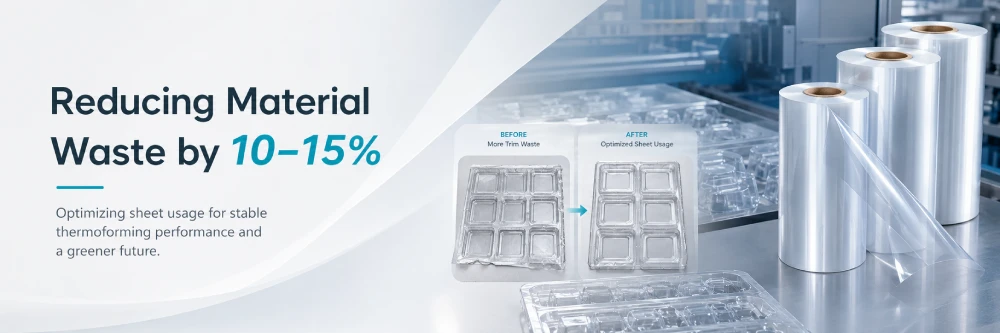
Featured Application · Blister Packaging
How to Choose Thermoforming Sheet for Blister Packaging
A practical sheet selection guide for blister packaging manufacturers and thermoforming converters choosing APET, PETG or PS/HIPS sheet rolls for retail, consumer and protective blister production.
Quick Answer
For clear retail blister packaging, APET is usually the first thermoforming sheet route to evaluate. PETG is worth considering when the blister requires deeper or more detailed forming and a wider processing window. PS/HIPS can suit selected opaque, colored or protective blister applications.
Material is only the starting point. Final sheet selection should also consider cavity depth, starting gauge, wall distribution, clarity, surface requirements, closure method, roll width and actual thermoforming conditions.
01 Choose the Sheet Material From the Blister Requirement
Blister sheet selection should start with what the finished package needs to do. Product visibility, cavity geometry, protection, appearance and the way the blister will be closed all affect the material route.
| Blister Requirement | Material to Evaluate First | Sheet Purchasing Consideration |
|---|---|---|
| Clear retail or consumer blister | APET | Clarity, stiffness, gauge, cavity depth, surface quality and trim behavior. |
| Deeper or more detailed clear cavity | PETG | Forming window, cavity definition, corner distribution, clarity and final rigidity. |
| Opaque or colored protective blister | PS / HIPS | Color, impact requirement, stiffness, gauge and cavity geometry. |
| High product visibility requirement | APET / PETG | Sheet clarity before forming, haze, surface quality and appearance after forming. |
| Demanding cavity or local detail | Material and gauge should be evaluated together | Draw depth, corner radii, wall distribution, tooling and thermoforming conditions. |
02 Specify Starting Gauge From Cavity Depth and Wall Distribution
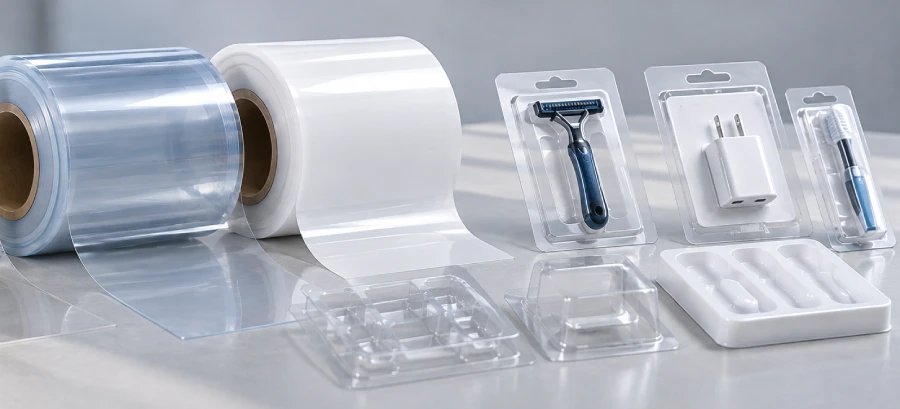
Starting sheet thickness is important, but the nominal gauge does not tell you how much material will remain at the bottom, walls and corners of the formed blister.
As the sheet is drawn into the cavity, material redistributes. Deeper cavities, tight corners and detailed shapes can create greater local thinning, which means gauge should be evaluated together with the actual blister geometry.
This is a useful application reference range, not DESU’s manufacturing thickness limit. The final starting gauge should be selected according to material, cavity depth, geometry, required rigidity, wall distribution and thermoforming conditions.
Deeper cavities generally increase the importance of wall distribution and local thinning.
Tight radii and detailed features can concentrate stretching in specific areas of the blister.
The formed blister must retain enough stiffness for handling, protection and the intended closure system.
03 Turn the Material Choice Into a Production Roll Specification
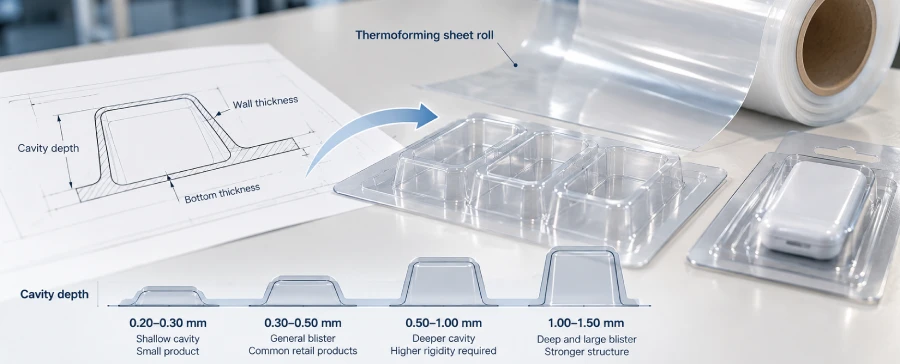
A material name and nominal thickness are not enough for repeat production. Once the material and starting gauge are selected, the roll specification should match the thermoforming line, tooling and finished blister requirements.
Parameters to Confirm Before Production
Why Roll Width Should Follow Tooling Layout
Roll width affects both machine compatibility and material utilization. For an existing line, the current successful roll width is the most useful reference. For a new tool, provide the tooling layout and machine feeding width where available.
04 Match Surface Requirements to the Blister Closure System
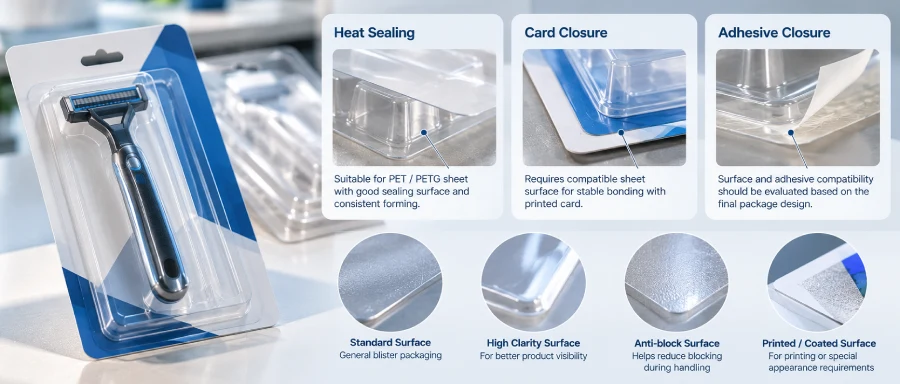
The thermoformed cavity is only one part of a blister package. The sheet may also need to work with a card, film, adhesive, heat-sealing process, printing operation or other closure system.
These requirements should be identified before production sheet is ordered, because the required surface or sheet structure can depend on how the finished blister will be assembled.
Heat Sealing
Confirm the mating material, sealing method and required sealing surface before specifying the sheet.
Adhesive / Card Closure
Where the blister is bonded to a printed card or other substrate, compatibility should be evaluated as part of the package system.
Printing & Surface
If printing, coating or a specific surface side is required, include it in the sheet specification rather than treating it as a later operation.
05 Approve the Sheet on the Actual Tool and Thermoforming Line
A sheet can meet its incoming material and thickness specification and still behave differently once it is heated, stretched into the cavity and trimmed.
Final approval should therefore include an actual forming trial, especially for a new cavity, deeper draw, material change, gauge reduction or new closure requirement.
Material, gauge, width, appearance and required surface.
Process the sheet on the intended thermoforming machine and blister tooling.
Check definition, corners, walls, clarity, flange and trim behavior.
Confirm formed-part and closure performance before regular roll supply.
What Should Be Checked After Forming?
- Cavity definition and dimensional consistency
- Wall and corner thickness distribution
- Whitening, cracking or excessive local stress
- Clarity and haze after forming where appearance matters
- Flange flatness and stability
- Trim quality and edge behavior
- Product fit and protective rigidity
- Closure or sealing performance where required
The purpose of the trial is not simply to prove that the sheet can be formed. It is to confirm that the selected specification works reliably with the customer’s tooling, machine, cavity geometry and package construction.
06 What to Send DESU for a Blister Sheet RFQ
If you already manufacture the blister, your current sheet specification is the fastest starting point. For a new project, send as much of the following information as you currently have.
Sheet thickness: ___ mm / not decided
Roll width: ___ mm
Appearance: clear / natural / white / colored
Blister dimensions: L ___ × W ___ × D ___ mm
Product / application: ___
Maximum cavity depth: ___ mm
Closure method: heat seal / adhesive / card / other / not decided
Surface requirement: standard / specific treatment / not decided
Machine feeding width: ___ mm / unknown
Core / roll OD / roll weight requirement: ___ / follow supplier recommendation
Drawing or formed sample: available / unavailable
Trial quantity: ___
Estimated production demand: ___
If some values are not yet known, leave them open. A blister drawing, existing formed sample, current sheet label or tooling information can often provide enough context to narrow the starting specification.
07 FAQ — Buying Thermoforming Sheet for Blister Packaging
Which plastic sheet is commonly used for clear blister packaging?
APET is a practical starting material for many clear retail and consumer blister applications. PETG may be considered when the cavity geometry or forming requirement benefits from a wider processing window. Final selection should be confirmed on the intended tooling and package design.
What thickness of sheet should I order for blister thermoforming?
A practical application reference for blister packaging is 0.20–1.50 mm, but this is not DESU’s manufacturing thickness limit or a universal recommendation. Starting gauge should be selected according to material, cavity depth, geometry, required rigidity and final wall distribution.
When should I consider PETG instead of APET?
PETG can be evaluated when a clear blister has deeper, more detailed or more demanding cavity geometry and the thermoforming process benefits from a wider forming window. The decision should still consider rigidity, appearance, closure requirements and actual forming conditions.
Will increasing sheet thickness solve a deep-draw blister problem?
Not necessarily. Higher starting gauge provides more material, but poor wall distribution can also result from cavity geometry, tight corner radii, heating profile, tooling or forming conditions. These factors should be reviewed together.
What information is most useful for a new blister project?
Provide the intended material if known, blister dimensions, maximum cavity depth, product type, required appearance, closure method, roll width or machine feeding width and any available drawing or sample.
Can I send my current blister sheet specification for equivalent supply?
Yes. For an existing production line, the current material, gauge, width, roll configuration and blister application provide the most useful starting reference. A sheet sample or formed blister can provide additional context where needed.
Does DESU manufacture finished blister packaging?
No. DESU supplies thermoforming plastic sheet and sheet rolls to blister packaging manufacturers and thermoforming converters that produce the finished packaging.
Sourcing Sheet Rolls for Blister Production?
Send us your current material, thickness, roll width and blister application. For a new project, include the cavity dimensions, maximum forming depth, closure method and any available drawing or sample. We can use that information to discuss a practical starting sheet specification for your thermoforming line.