Featured Application · Food Tray Sheet
How to Choose Thermoforming Sheet for Food Tray Production
A practical sheet selection guide for thermoforming manufacturers and packaging converters choosing APET, RPET, PP or PS/HIPS sheet rolls for food tray production.
Quick Answer
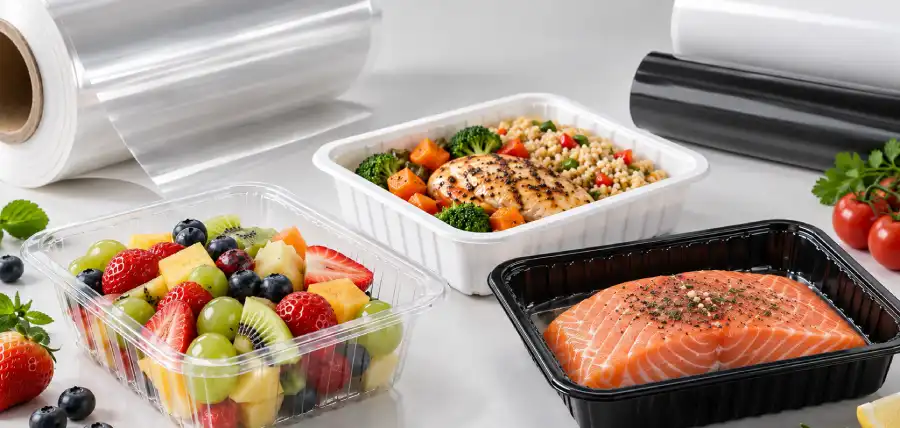
For clear fresh and chilled food trays, APET or RPET is usually the first thermoforming sheet route to evaluate. For applications involving higher filling or use temperatures, PP is generally the more relevant starting point. PS/HIPS can suit selected opaque, rigid, refrigerated or frozen-food trays.
Material is only the starting point. Final sheet selection should also consider starting gauge, forming depth, rigidity, roll width, appearance, anti-fog, sealing and barrier requirements.
01 Choose the Sheet Material From the Application Requirement
A useful food-tray sheet inquiry should not begin with “Which plastic is best?” Material selection should start from the conditions that the sheet will face after it is thermoformed.
| Buyer Requirement | Material to Evaluate First | Sheet Purchasing Consideration |
|---|---|---|
| Clear fresh, produce or chilled-food tray | APET | Clarity, stiffness, gauge, forming depth, anti-fog and sealing requirements. |
| Recycled-content requirement | RPET | Recycled-content specification, appearance and thermoforming performance. |
| Higher filling or use temperature | PP | Actual temperature conditions, stiffness, gauge and forming window. |
| Opaque or colored rigid food tray | PS / HIPS | Color, impact requirement, stiffness, temperature and final tray geometry. |
| Sealed tray requiring additional barrier | PET-based multilayer / barrier structure | Lidding film, sealing system, oxygen/moisture requirement and shelf-life target. |
02 Specify Starting Sheet Gauge From the Formed Part
Sheet thickness is one of the first numbers buyers include in an RFQ, but nominal starting gauge should not be selected independently from the thermoformed geometry.
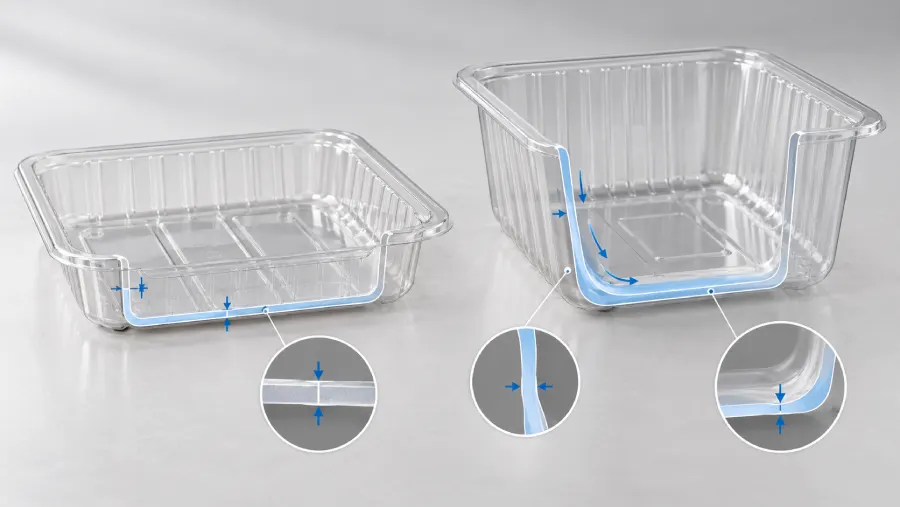
During forming, the sheet stretches and redistributes into the cavity. A deeper draw or more demanding geometry can produce greater thinning at sidewalls, corners and the bottom of the tray.
This is a useful application reference range, not DESU’s manufacturing thickness limit. The final starting gauge should be confirmed according to material, tray depth, geometry, required rigidity and thermoforming conditions.
Deeper cavities generally require more attention to material distribution and minimum final wall thickness.
Tight corners and local geometry can create concentrated thinning during forming.
The tray must remain sufficiently stable after forming, filling, stacking and handling.
For an existing production line, the current successful material and gauge are normally the best starting benchmark. If the current tray has weak walls, whitening or unstable forming, increasing gauge is not automatically the only answer.
Heating profile, material distribution, mold geometry and machine conditions should also be considered before changing the sheet specification.
03 A Purchase Order Needs More Than Material and Thickness
“APET 0.5 mm” is not a complete production-roll specification. Once the material and approximate gauge are established, the physical roll specification must also match the thermoforming line.
Parameters to Confirm Before Production
Why Roll Width Should Follow the Mold Layout
Roll width affects material utilization as well as machine compatibility. For an existing line, send the current roll width. For a new mold, provide the mold layout, number of cavities and machine feeding width where available.
04 Add Functional Requirements Only When the Package Needs Them
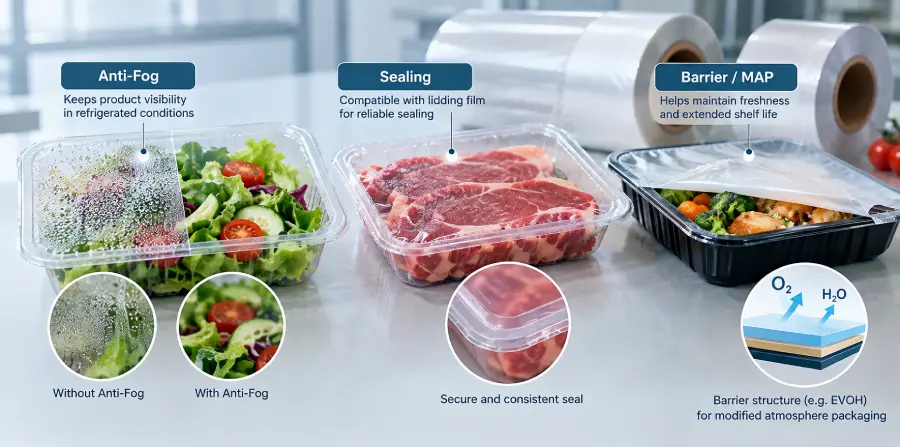
Food-grade thermoforming sheet does not automatically need every available surface treatment or multilayer structure. Functional requirements should be defined from the actual packaging system.
Anti-Fog Sheet
Consider anti-fog when condensation reduces visibility in chilled produce, fresh-food or other refrigerated packaging.
Sealing Compatibility
When the formed tray is sealed with lidding film, the sheet structure, film and sealing conditions should be evaluated together.
Barrier Structure
Meat, fish, cheese, MAP and longer-shelf-life applications may require additional oxygen or moisture barrier performance.
Where a standard mono sheet is not sufficient, DESU can discuss suitable multilayer or barrier sheet structures according to the customer’s sealing system and required package performance.
05 Approve the Sheet on the Actual Thermoforming Line
Incoming sheet measurements are important, but final approval should also include the way the sheet behaves on the intended machine and mold.
This is especially important when changing material, reducing gauge, moving to recycled-content sheet, introducing a functional coating or running a new mold.
Material, gauge, width and required functionality.
Process the sheet on the intended machine and tooling.
Check cavity definition, corners, walls and trim behavior.
Confirm formed-part performance before regular roll supply.
What Should Be Checked After Forming?
- Wall and corner thickness distribution
- Cavity definition and forming consistency
- Tray stiffness after forming
- Whitening, haze or visible surface defects
- Flange and rim stability
- Trim behavior
- Stacking and denesting where relevant
- Sealing or anti-fog performance where specified
The purpose of the trial is not to redesign the tray. It is to confirm that the purchased sheet specification works reliably with the customer’s existing mold, machine and production conditions.
06 What to Send DESU for a Food Tray Sheet RFQ
A useful RFQ does not need to be complicated. If you already run food trays, start with your existing sheet specification. For a new project, send as much of the following information as you have.
Sheet thickness: ___ mm / not decided
Roll width: ___ mm
Color / appearance: clear / natural / white / colored
Tray dimensions: L ___ × W ___ × D ___ mm
Food / application: ___
Storage condition: ambient / refrigerated / frozen
Filling / use temperature: ___
Anti-fog: yes / no / not decided
Sealing: yes / no / not decided
Barrier / MAP: yes / no / not decided
Machine feeding width: ___ mm / unknown
Core / roll OD / roll weight requirement: ___ / follow supplier recommendation
Drawing or formed sample: available / unavailable
Trial quantity: ___
Estimated production demand: ___
If some values are not yet known, leave them open. A tray drawing, current sheet label, existing sample or machine information can often provide enough context to narrow the starting specification.
07 FAQ — Buying Thermoforming Sheet for Food Trays
What information should I provide when buying food tray sheet rolls?
Start with the material, thickness, roll width, tray dimensions and application. Also provide storage or use temperature and any anti-fog, sealing or barrier requirements. For an existing production line, the current sheet specification is especially useful.
What thickness of sheet should I order for food tray thermoforming?
A practical reference range for many food-tray applications is 0.30–1.50 mm, but this is not a manufacturing limit or a universal recommendation. Starting gauge should be selected according to material, forming depth, geometry, required rigidity and final wall distribution.
Can DESU recommend a starting gauge from my existing tray?
Yes. The most useful references are the current material and gauge, tray dimensions and depth, formed sample, mold information and any performance problem you are trying to solve.
Should I buy APET or RPET for clear food trays?
Both can be evaluated for clear thermoformed food packaging. The choice depends on the recycled-content requirement, appearance target, forming performance and the specification required for the final package.
Do I need anti-fog PET sheet for every refrigerated tray?
No. Anti-fog should be specified when condensation affects product visibility or package presentation. Standard sheet may be sufficient where condensation is not a practical issue.
Can I send my current sheet specification for an equivalent supply?
Yes. For an existing thermoforming line, sending the current material, gauge, width, roll configuration and application is normally the fastest starting point. A sheet sample or formed tray can provide additional reference where needed.
Does DESU supply finished food trays?
No. DESU supplies thermoforming plastic sheet and sheet rolls to thermoforming factories and packaging converters that manufacture the finished trays.
Sourcing Sheet Rolls for Food Tray Production?
Send us your current material, thickness, roll width and application. For a new project, include the tray dimensions, forming depth and functional requirements. We can use that information to discuss a practical starting sheet specification for your thermoforming line.