Featured Application · Toy & Consumer Product Packaging
How to Choose Thermoforming Sheet for Toy & Consumer Product Packaging
A practical sheet selection guide for thermoforming manufacturers and packaging converters choosing APET, RPET or HIPS sheet rolls for toys, household goods, personal-care products, accessories and other consumer product packaging.
Quick Answer
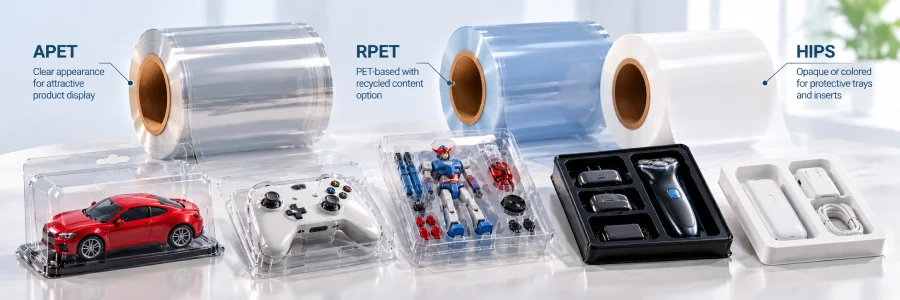
For clear retail packaging where the product should remain highly visible, APET is usually the first thermoforming sheet route to evaluate. RPET can be considered when recycled content is part of the project requirement while retaining a PET-based packaging route. For opaque or colored trays, inserts and protective packaging, HIPS is an important option where rigidity, cavity definition and product positioning matter.
Final sheet selection should also consider product size and weight, cavity depth, package geometry, required rigidity, appearance, surface quality, roll width and actual thermoforming conditions.
01 Choose the Sheet Material From the Packaging Requirement
Toy and consumer product packaging covers a wide range of thermoformed structures. Some packages are designed primarily to display the product clearly, while others use a formed tray or insert to locate, separate and protect the product inside an outer package.
The first material decision should therefore start with the required package function: visibility, protection, appearance and cavity geometry.
| Packaging Requirement | Material to Evaluate First | Sheet Purchasing Consideration |
|---|---|---|
| Clear retail display packaging | APET | Clarity, surface quality, gauge, cavity depth, rigidity and appearance after forming. |
| Clear PET packaging with recycled-content requirement | RPET | Recycled-content requirement, appearance, forming performance and project specification. |
| Opaque or colored product tray | HIPS | Color, rigidity, product weight, cavity definition and impact requirement. |
| Internal tray with multiple product cavities | HIPS | Product positioning, cavity detail, wall distribution, rigidity and denesting. |
| Deep or detailed clear package | APET / RPET — evaluate geometry with gauge | Draw depth, local thinning, corner geometry, clarity after forming and required rigidity. |
| Larger or heavier consumer product | Material and gauge should be evaluated together | Product weight, tray span, cavity geometry, handling loads and final package stiffness. |
02 Specify Starting Gauge From Product and Package Geometry
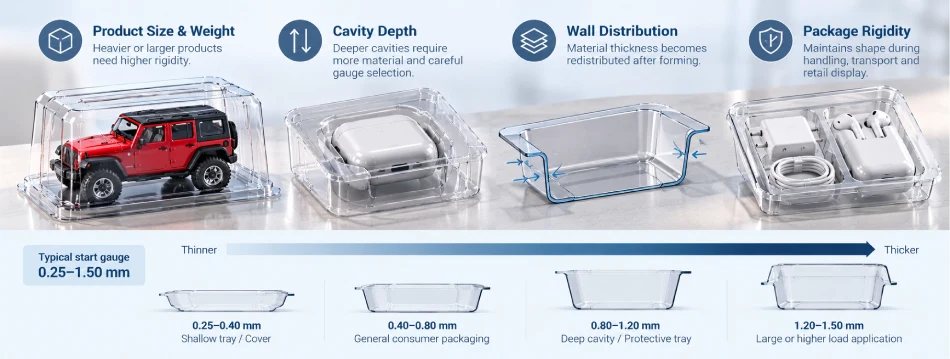
Starting gauge should provide enough material for the sheet to form around the required cavity while maintaining the rigidity needed to hold and protect the product.
The correct gauge is influenced not only by cavity depth, but also by product weight, tray span, corner geometry and how much material is redistributed during forming.
This is a useful application reference range, not DESU’s manufacturing thickness limit. Final starting gauge should be selected according to material, product weight, package dimensions, forming depth, required rigidity, wall distribution and thermoforming conditions.
Larger or heavier products can place greater demands on tray stiffness and support areas.
Deeper cavities stretch more material into the mold and increase the importance of wall distribution.
The formed part should maintain its shape during packing, handling, transport and retail display.
03 Balance Product Visibility, Protection and Presentation
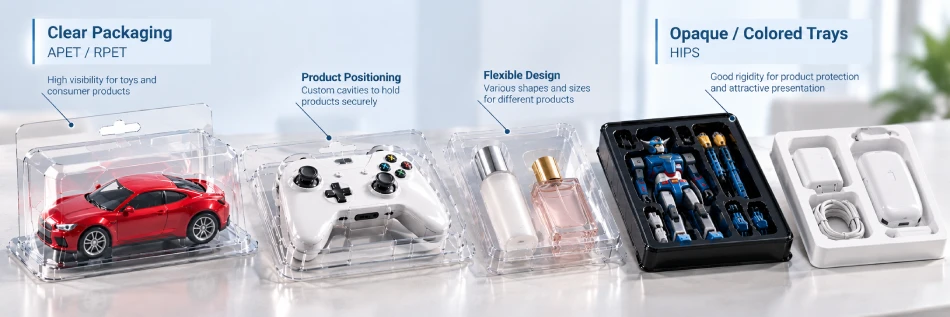
Consumer packaging often has two jobs at the same time: present the product attractively and keep it correctly positioned during packing, transport and retail handling. The importance of each function changes with the package design.
Product Visibility
Clear APET or RPET packaging can keep toys, accessories and consumer products visible while providing a formed protective structure.
Product Protection
A formed tray or insert should locate the product securely enough to reduce unwanted movement and protect critical areas during handling.
Appearance & Branding
HIPS provides an important route for opaque, white or colored trays where the package itself forms part of the visual presentation.
Cavity Geometry Should Follow the Product
Multiple components, accessories and irregular product shapes can require detailed cavities, retaining features or different cavity depths within the same tray. These features affect material distribution during forming.
For a new project, a product drawing, tray drawing or sample can therefore be more useful than simply requesting “sheet for toy packaging.”
04 Turn the Selection Into a Production Roll Specification
After the material and starting gauge are selected, the sheet requirement should be converted into a production roll specification that matches the thermoforming machine, mold layout and finished package.
Parameters to Confirm Before Production
Roll Width Should Follow the Mold Layout
Roll width should be matched to machine feeding width and cavity layout. This is especially relevant for multi-cavity toy trays and consumer-product inserts, where the sheet width affects both machine compatibility and material utilization.
05 Approve the Sheet on the Actual Product Packaging Tool
Final approval should be based on the formed package, not only the incoming sheet. The same nominal sheet can behave differently when cavity depth, product geometry, mold design or thermoforming conditions change.
A trial is particularly important for a new mold, deeper cavity, heavier product, material change or gauge reduction.
Material, gauge, width, appearance and package requirements.
Form the sheet on the intended machine and production mold.
Check cavities, walls, corners, rigidity and appearance.
Confirm product fit, positioning and package stability before regular supply.
What Should Be Checked After Forming?
- Cavity definition and product fit
- Wall and corner thickness distribution
- Rigidity under the actual product load
- Clarity and surface appearance for clear packaging
- Color and surface consistency for HIPS trays
- Whitening or visible stress in deep areas
- Flange and trim quality
- Product movement inside the formed cavity
- Stacking and denesting where relevant
The purpose of the trial is to confirm that the selected sheet works reliably with the customer’s machine, mold, product and package geometry.
06 What to Send DESU for a Consumer Packaging Sheet RFQ
For an existing package, start with the current sheet specification. For a new project, send as much of the following information as you currently have.
Package type: clear pack / tray / insert / cover / other
Material: APET / RPET / HIPS / not decided
Sheet thickness: ___ mm / not decided
Roll width: ___ mm
Appearance: clear / natural / white / colored
Package dimensions: L ___ × W ___ × D ___ mm
Maximum forming depth: ___ mm
Product dimensions / weight: ___
Special appearance or surface requirement: ___ / none
Machine feeding width: ___ mm / unknown
Core / roll OD / roll weight requirement: ___ / follow supplier recommendation
Drawing or formed sample: available / unavailable
Trial quantity: ___
Estimated production demand: ___
If the specification is still being developed, a product sample, tray drawing, cavity dimensions or existing formed package can provide useful context for defining the starting sheet.
07 FAQ — Buying Sheet for Toy & Consumer Product Packaging
Which sheet material is suitable for clear toy packaging?
APET is a practical starting route for many clear toy and consumer-product packages where product visibility is important. The final specification should also consider cavity depth, product weight, required rigidity and appearance after forming.
When should RPET be considered?
RPET can be evaluated when recycled content is part of the packaging requirement and a PET-based thermoforming solution is suitable. Recycled-content and appearance requirements should be defined for the individual project.
When is HIPS useful for consumer product packaging?
HIPS is an important route for opaque or colored trays and inserts where product positioning, cavity definition and formed-part rigidity are more important than transparent product display.
What sheet thickness should I use?
A practical application reference range is 0.25–1.50 mm, but this is not DESU’s manufacturing thickness limit or a universal recommendation. Material, product weight, cavity depth, geometry and required rigidity should be considered together.
Does a heavier product always require thicker sheet?
Not automatically. Product weight is important, but cavity geometry, tray span, support points, material choice and wall distribution also affect the rigidity of the finished package.
Can this sheet also be used for electronics packaging?
Standard APET, RPET or HIPS may be used for some general consumer products, but electronics that require anti-static, conductive or controlled surface-resistance performance should be specified separately under the Electronics Packaging application.
Does DESU manufacture finished toy trays or consumer packaging?
No. DESU manufactures thermoforming plastic sheet and sheet rolls supplied to packaging manufacturers and thermoforming converters that produce the finished trays, inserts and retail packages.
Sourcing Sheet Rolls for Consumer Product Packaging?
Send us your package type, current material, thickness and roll width. For a new project, include the product dimensions and weight, package dimensions, forming depth, required appearance and any available drawing or sample. We can use that information to discuss a practical starting sheet specification for your thermoforming line.