Quick Answer
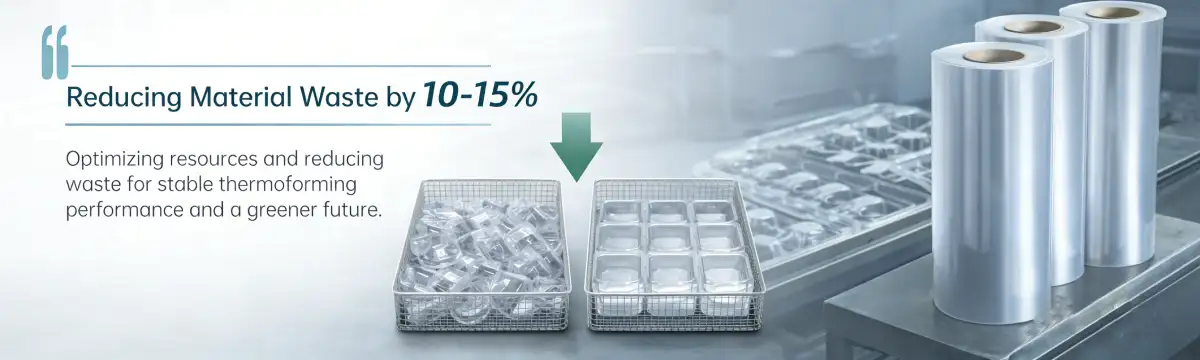
To improve thermoforming results with PET sheet, you need to optimize temperature control, select the correct intrinsic viscosity (IV), ensure uniform heating, use consistent thickness material, and match the mold design to the application.
What Does “Improving Forming Results” Mean?
Improving forming results refers to achieving:
- consistent product quality
- fewer defects
- stable production performance
👉 In summary: Better forming results come from optimizing both material selection and processing conditions.
Key Factors to Improve PET Thermoforming Performance
| Factor | Impact | Optimization Method |
|---|---|---|
| Temperature | Forming quality | Adjust within proper range |
| IV (Intrinsic Viscosity) | Strength & stretchability | Match to application |
| Thickness Consistency | Uniform forming | Use high-quality sheet |
| Heating Uniformity | Surface quality | Use multi-zone heating |
| Mold Design | Shape accuracy | Optimize vents & geometry |
Core Ways to Improve Forming Results
1. Optimize Thermoforming Temperature
- Too low → incomplete forming
- Too high → defects (webbing, bubbles)
👉 In summary: Maintaining the correct temperature range is the foundation of good forming results.
📌 Related Reading:Recommended Thermoforming Temperature for PET Sheet
2. Select the Right IV (Intrinsic Viscosity)
- Low IV → easier forming but weaker
- High IV → stronger but harder to form
👉 In summary: Matching IV with forming depth is critical for stable results.
📌 Related Reading: What is IV in PET Sheet
3. Ensure Uniform Heating
Uneven heating leads to:
- inconsistent stretching
- thickness variation
Solutions:
- multi-zone heating systems
- proper heater distance
👉 In summary: Uniform heating is more important than increasing temperature.
4. Use PET Sheet with Consistent Thickness
Material inconsistency causes:
- weak points
- uneven forming
👉 In summary: High-quality PET sheet reduces forming variability.
5. Improve Mold Design
Key improvements:
- proper venting
- smooth transitions
- optimized depth
👉 In summary: Mold design directly affects forming precision and defect rate.
6. Control Heating Time and Cycle Time
- Short time → insufficient forming
- Long time → overheating
👉 In summary: Balance between time and temperature is essential.
⚠️Common Mistakes That Reduce Forming Quality
| Mistake | Result |
|---|---|
| Ignoring IV | unstable forming |
| Poor temperature control | defects |
| Uneven heating | inconsistent products |
| Low-quality sheet | high scrap rate |
👉 In summary: Most forming issues come from ignoring material-process matching.
🏭Factory Insight (15 Years Experience)
From real production environments:
- Many customers try to fix issues by adjusting machines only
- But in most cases, the root cause is:
- incorrect material selection
- unstable sheet quality
👉 In summary: Material consistency is often more important than machine settings.
Procurement Guide: How to Choose PET Sheet for Better Forming
When selecting PET sheet, prioritize:
- stable IV range
- tight thickness tolerance
- low moisture content
- reliable supplier quality control
👉 In summary: Choosing the right PET sheet supplier is key to improving forming performance.
📈 Process Optimization Strategy
To achieve the best results:
- Match IV with forming depth
- Adjust temperature based on thickness
- Ensure even heating distribution
- Optimize mold structure
👉 Best practice:
Material + Temperature + Mold + Process control must work together
FAQ
Q1: How can I improve thermoforming quality of PET sheet?
A: Optimize temperature, select the correct IV, ensure uniform heating, and use consistent material.
Q2: What is the most important factor in thermoforming?
A: Temperature control is the most critical factor.
Q3: Does PET sheet quality affect forming results?
A: Yes. Thickness consistency and IV stability are essential.
Q4: How to reduce defects in PET thermoforming?
A: Control temperature, improve mold design, and use high-quality PET sheet.
Q5: Can machine settings alone fix forming issues?
A: No. Material selection plays a major role.
Final Conclusion
Improving thermoforming results with PET sheet requires a combination of correct temperature control, proper IV selection, consistent material quality, and optimized mold design. A balanced approach ensures stable production and high-quality output.