Featured Application · Electronics Packaging
Cómo elegir una lámina de termoformado para envases electrónicos
A practical sheet selection guide for thermoforming manufacturers and packaging converters choosing PET, PP or PS/HIPS sheet rolls for electronic product trays, component inserts, ESD trays and conductive packaging.
Respuesta rápida
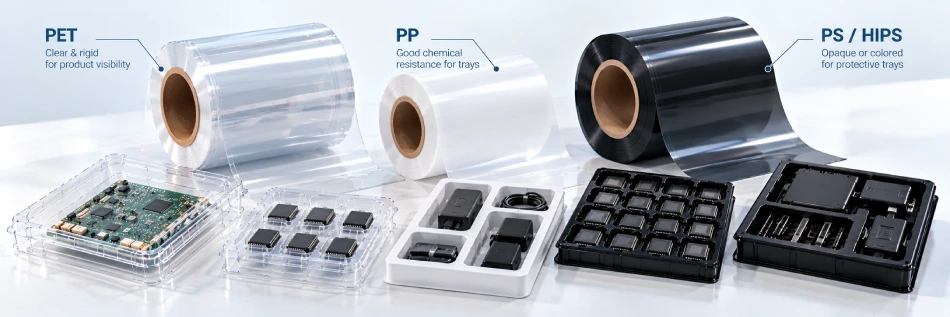
For electronics packaging, first decide whether the tray needs only physical protection or also requires electrostatic control. PET, PP and PS/HIPS can all be relevant thermoforming sheet routes, but the correct choice depends on product sensitivity, required surface resistance, tray geometry, rigidity, appearance and forming depth.
If ESD performance is required, do not specify only “anti-static sheet.” Define the required resistance range and whether the requirement must remain effective after thermoforming.
01 Start With the Electronic Product and Required Protection
Electronics packaging ranges from ordinary protective trays for finished devices to controlled ESD packaging for sensitive components. These applications should not automatically use the same sheet specification.
Start by defining what the thermoformed tray will hold, how sensitive the product is, and what the tray must do during production, handling, storage and transport.
| Packaging Requirement | Sheet Route to Evaluate | Purchasing Consideration |
|---|---|---|
| Clear protective tray or cover | MASCOTA | Clarity, rigidity, cavity depth, surface quality and forming performance. |
| General opaque electronic product tray | PS/HIPS or PP | Rigidity, impact requirement, cavity definition, color and product load. |
| Anti-static component tray | Functional PET / PP / PS-HIPS | Required resistance range, persistence of ESD performance, forming depth and final tray performance. |
| Conductive tray for sensitive components | Conductive PS/HIPS or PP | Target resistance, black appearance, formed-part consistency and cavity geometry. |
| Deep component tray or precision insert | Material, ESD function and gauge should be evaluated together | Draw depth, wall distribution, cavity detail, resistance after forming and required rigidity. |
02 Decide Whether the Tray Needs Anti-Static or Conductive Performance
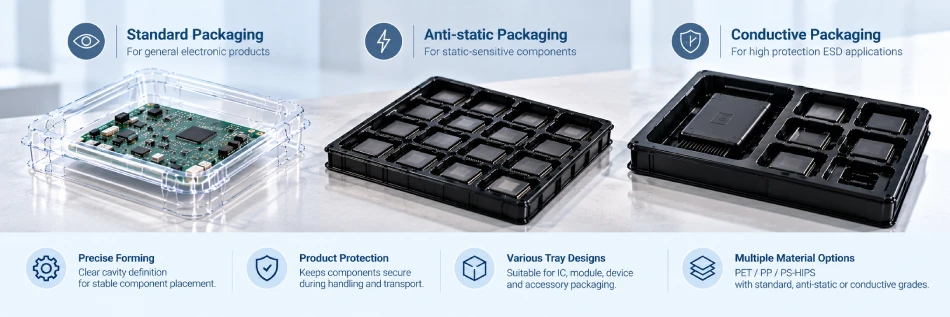
This is the most important additional decision in electronics packaging. Standard plastic sheet and ESD-control sheet may look similar before forming, but they are not interchangeable when the packaged component has an electrostatic protection requirement.
Standard Protective Sheet
Used where the main requirement is physical positioning, protection, appearance or rigidity and no controlled ESD property is specified.
Anti-Static Sheet
Used when the application requires controlled static dissipation. The target resistance range and required duration of the effect should be confirmed before production.
Conductive Sheet
Used for applications requiring substantially lower electrical resistance. Conductive grades are commonly associated with black functional sheet and should be specified by resistance target.
Specify a Resistance Target, Not Just an ESD Label
Terms such as “ESD,” “anti-static” and “conductive” are useful descriptions, but they are not complete purchasing specifications. For an electronics project, the required electrical range should be confirmed wherever the customer or end user has defined one.
DESU conductive carbon-black PS/HIPS can be supplied in a 103–106 Oh surface-resistance range for relevant ESD tray applications. The required resistance should still be confirmed for the individual project.
03 Select Starting Gauge From Product Load and Tray Geometry
Electronics trays can range from shallow component carriers to deep protective inserts for larger devices. Starting gauge therefore needs to be evaluated with product weight, cavity depth and required rigidity.
This is a useful application reference range, not DESU’s manufacturing thickness limit. Final starting gauge should be selected according to material, product load, cavity depth, required rigidity, ESD requirement, wall distribution and forming conditions.
Larger devices or heavier components can require greater formed-part rigidity and stronger support areas.
Deeper cavities redistribute more material and increase the risk of local thinning.
Component pockets, ribs and retaining features require sufficient forming definition and stability.
For functional sheet, geometry and draw depth may also influence electrical performance across the finished tray.
04 Validate Mechanical and ESD Performance After Thermoforming
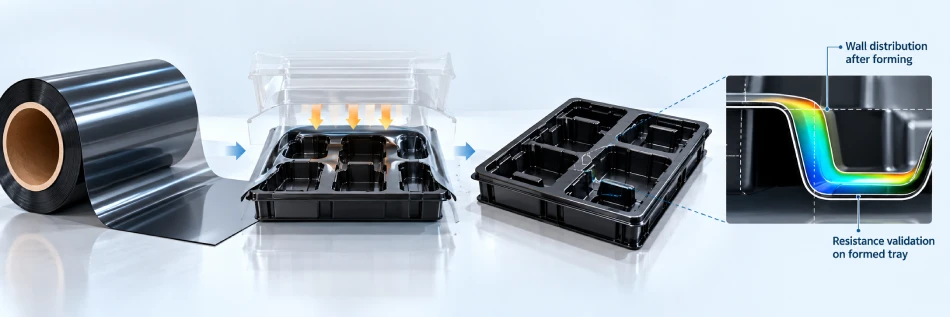
For electronics packaging, incoming sheet inspection alone is not enough. The tray should be evaluated after it has been heated, stretched into the mold and trimmed to its final geometry.
Why Deep Draw Matters More for Functional Sheet
A deep cavity stretches the sheet more heavily than a shallow tray. Besides reducing local wall thickness, this can change how a functional layer or conductive network behaves in the finished part.
For this reason, projects involving deeper ESD trays should be validated using the intended mold or a representative forming trial rather than relying only on flat-sheet measurements.
05 Turn the Requirement Into a Production Roll Specification
Once the material, ESD requirement and starting gauge have been defined, they need to be converted into a complete sheet-roll specification for the thermoforming line.
Parameters to Confirm Before Production
06 What to Send DESU for an Electronics Packaging Sheet RFQ
For an existing electronics tray, start with the current specification. For a new project, send as much of the following information as you have.
Product or component: ___
Material: PET / PP / PS-HIPS / not decided
ESD requirement: none / anti-static / conductive / not decided
Target resistance: ___ Ω / not specified
Sheet thickness: ___ mm / not decided
Roll width: ___ mm
Appearance: clear / natural / white / black / other
Tray dimensions: L ___ × W ___ × D ___ mm
Maximum forming depth: ___ mm
Product weight: ___
Machine feeding width: ___ mm / unknown
Core / roll OD / roll weight: ___ / follow supplier recommendation
Drawing or formed sample: available / unavailable
Trial quantity: ___
Estimated production demand: ___
If the exact material is not yet decided, the component, resistance requirement, tray drawing and maximum forming depth can provide enough information to begin narrowing the appropriate sheet route.
07 FAQ — Buying Thermoforming Sheet for Electronics Packaging
Does every electronics tray need ESD sheet?
No. Some trays are used primarily for physical protection, positioning or presentation and do not require controlled electrostatic performance. ESD sheet should be specified when the component or packaging process requires it.
What is the difference between anti-static and conductive sheet?
They refer to different levels of electrical behavior. Rather than relying only on the label, specify the required surface-resistance range and whether the performance must remain stable after thermoforming.
Which materials can be used for ESD thermoforming sheet?
PET, PP and PS/HIPS can all be relevant depending on the required electrical performance, appearance, tray geometry and forming conditions. The correct route should be selected from the project requirement rather than the resin name alone.
What thickness should I use for an electronics tray?
A practical application reference range is 0.30–2.00 mm, but this is not DESU’s manufacturing thickness limit or a universal recommendation. Product load, cavity depth, rigidity, material and ESD requirements should be considered together.
Can conductive HIPS be thermoformed into deep trays?
Conductive HIPS can be used for thermoformed electronics trays, but deeper geometries should be validated carefully because material stretching affects both wall distribution and the performance of the formed part.
Should resistance be tested before or after thermoforming?
Flat-sheet testing is useful for incoming material control, but where the formed tray has a defined ESD requirement, the finished thermoformed part should also be evaluated, especially in highly stretched areas.
Does DESU manufacture finished ESD trays?
No. DESU manufactures thermoforming plastic sheet and sheet rolls supplied to thermoforming factories and packaging converters that produce the finished electronics trays and inserts.
Sourcing Sheet Rolls for Electronics Packaging?
Send us the product or component, required material, ESD level or target resistance, sheet thickness and roll width. For a new project, include tray dimensions, forming depth, product weight and any available drawing or sample. We can use that information to discuss a practical starting sheet specification.