Application Material Selection Guide
印刷折り箱用PETシートの選び方
For transparent printed folding boxes, virgin APET is generally our preferred starting material. Its clarity, surface cleanliness and consistent appearance are important, but successful conversion also depends on print adhesion, sheet thickness, creasing performance and roll quality.
01 What Does a Printed Folding Box Require from PET Sheet?
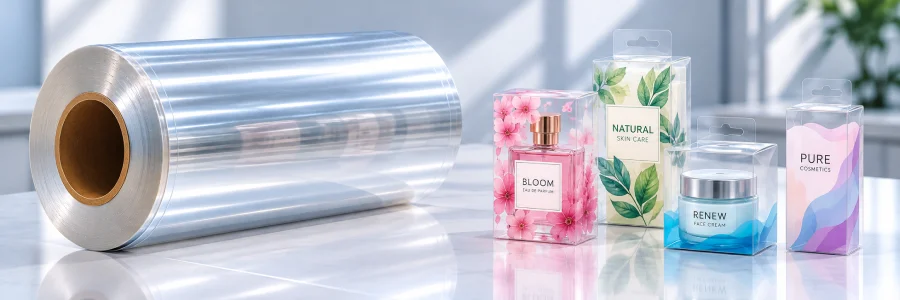
Transparent plastic folding boxes are used for cosmetics, gift packaging, stationery, toys and retail product displays. Their main attraction is simple: customers can see the product while the packaging still carries printed graphics, branding and product information.
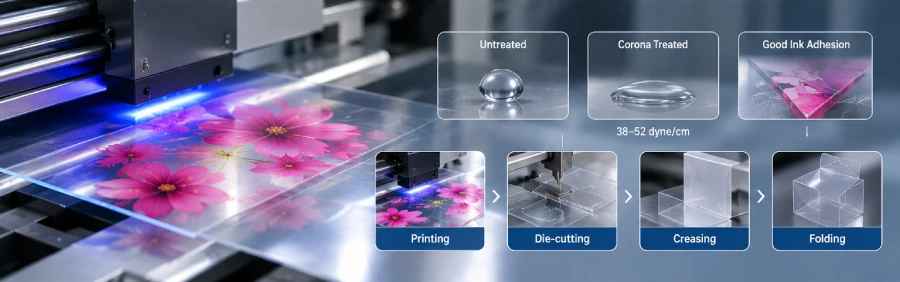
For the printing and converting company, however, a good-looking transparent sheet is only the starting point. The material must also pass through printing, die-cutting, creasing and folding without creating unacceptable appearance or processing problems.
We normally focus on five sheet-related requirements: optical clarity, surface cleanliness, print adhesion, suitable stiffness and consistent thickness. If one of these is overlooked, the problem may not become visible until the sheet reaches the converting line.
02 Why We Recommend Virgin APET for Printed Folding Boxes
For this particular application, our recommendation is straightforward: start with virgin APET rather than treating all PET sheet grades as interchangeable.
Premium transparent folding boxes expose even small differences in sheet appearance. Slight color variation, visible particles, gels or surface defects may be much more noticeable here than in applications where the sheet is opaque or covered by other packaging materials.
Virgin APET gives us a more suitable starting point for controlling these appearance requirements. It is also a practical material for printing, die-cutting and folding when the sheet grade and processing conditions are properly matched.
| Selection factor | Why it matters for folding boxes |
|---|---|
| 高い透明性 | Helps maintain a clear view of the packaged product and supports premium presentation. |
| Low visible particle and gel content | Reduces the risk of appearance defects interfering with printing and display quality. |
| Consistent color and clarity | Helps converters maintain a uniform appearance between production batches. |
| Controlled surface finish | Supports printing quality and helps manage visible handling marks. |
| Suitable stiffness and bending response | Supports box rigidity while allowing the intended creasing and folding operations. |
Why don’t we generally recommend RPET here?
RPET can be a useful material in many packaging applications, including thermoformed trays and containers. But for premium transparent printed folding boxes, our material preference is different.
Depending on the recycled feedstock and production controls, RPET may introduce additional challenges with color consistency, visible particles, gels and surface appearance. These differences matter when a customer expects transparent packaging to look consistent across repeated orders.
This does not mean every RPET grade is unsuitable for printing. It means that, for the folding-box applications discussed here, DESU generally recommends virgin APET as the more appropriate material direction.
03 Match Surface Treatment to the Printing Process
One of the most common purchasing mistakes is specifying only “クリアペットシート” when the material will actually be printed.
A sheet can have excellent transparency but still require additional surface preparation for the chosen ink system. This is why we ask about the printing method before confirming the sheet specification.
DESU can discuss customizable corona treatment within a stated range of 38–52 dyne/cm, depending on the project requirements. The target treatment level should be selected in relation to the ink system, printing process and converter’s adhesion criteria.
| Printing process | What to confirm before ordering |
|---|---|
| UV printing | Ink adhesion, curing conditions and compatibility with the treated PET surface. |
| Screen printing | Ink compatibility, surface treatment and adhesion after drying or curing. |
| Offset printing | Suitable ink system, feeding behavior, surface quality and print adhesion. |
Corona treatment is not a permanent guarantee of printability. Surface condition may change during storage, and the treatment level alone cannot predict how every ink will perform.
For that reason, we recommend checking the actual printing and adhesion performance on representative material before approving a production order.
04 Clarity, Surface Cleanliness and Scratch Control
Transparent folding boxes leave little room to hide material defects. Fine scratches, surface marks, haze or visible particles can become obvious under retail lighting, particularly against dark products or printed backgrounds.
For this reason, surface quality should be treated as part of the purchasing specification, not merely as a visual preference.
We pay attention to sheet appearance, surface finish and appropriate slip behavior because these factors influence handling during printing, stacking and die-cutting.
However, no sheet grade can completely eliminate scratching during conversion. Machine contact, stacking pressure, protective measures and handling practices also affect the finished result.
If a project has particularly demanding appearance requirements, buyers should discuss surface protection options and confirm their compatibility with printing and folding.
05 Choosing APET Thickness for Die-Cutting and Folding
For the folding-box and printing applications discussed here, our recommended starting thickness range is 0.25–0.50 mm。
The exact thickness should reflect the finished box dimensions, required rigidity and the converter’s cutting and creasing process. Choosing the thickest sheet is not always the best solution.
A thicker APET sheet may provide better panel stiffness, but it can also increase folding resistance and place greater demands on crease design. A thinner sheet may fold more easily but may not provide sufficient rigidity for larger boxes or heavier contents.
| Requirement or problem | Sheet selection consideration |
|---|---|
| Insufficient box rigidity | Review APET thickness, stiffness and box dimensions. |
| White marks along folds | Check grade, gauge and compatibility with the creasing process. |
| Cracking during folding | Review sheet bending behavior, crease conditions and thickness. |
| Excessive spring-back | Evaluate the balance between sheet stiffness and folding requirements. |
| Inconsistent cutting | Check gauge consistency, flatness and material feeding. |
Virgin APET is a suitable starting material for clean die-cutting and folding, but crease appearance depends on both the material and the converter’s process.
We would rather review a sample box or folding requirement before recommending a specific gauge than assume one thickness works for every design.
06 Roll Width, Flatness and Supply Format Also Matter
Even when the material grade is correct, unsuitable roll specifications can create unnecessary problems during printing and converting.
Sheet curl, thickness variation and inconsistent winding can affect feeding, registration and cutting performance. For printed packaging, these issues may also influence the alignment of graphics and die-cut positions.
Before placing an order, confirm the required width, thickness tolerance, roll core, winding direction and any roll diameter restrictions. If the process uses cut sheets, specify the dimensions and flatness requirements.
For treated material, the treated-side orientation should also be included in the supply specification.
DESU supplies PET material in roll and sheet formats. The most practical supply format depends on how the converter feeds and processes the material.
07 What Should Be Checked During Production Trials?
For a new printed folding-box project, we suggest evaluating the sheet through the actual converting sequence rather than approving it from appearance alone.
Printing and adhesion
Check the intended ink system on the specified treated surface. Review adhesion after the relevant drying, curing and handling conditions.
Die-cutting and creasing
Confirm cutting consistency and look for unacceptable whitening or cracking along the intended folds.
Surface appearance
Inspect the material after printing, stacking and folding, not only before processing.
Production feeding
Check flatness, curl and feeding behavior using a supply format representative of the intended production order.
08 Request Virgin APET Sheet for Your Folding Box Project
If you manufacture transparent printed folding boxes, the most useful starting point is a clear description of your material and printing requirements.
You do not need to finalize every detail before contacting us. We can discuss a suitable APET sheet direction based on your application and processing needs.
APET Folding Box Sheet RFQ Checklist
- Application: gift box, window display box, printed transparent box or other design
- Material: virgin APET
- Target thickness: within or around the recommended 0.25–0.50 mm range
- Printing process: UV, screen, offset or other system
- Corona treatment requirements: target dyne level and treated side
- Transparency, surface cleanliness and scratch appearance requirements
- Roll width or cut-sheet dimensions
- Core, winding direction and other equipment requirements
- Expected order quantity and sample or trial needs
If you already have a sample or drawing of the folding box, sharing it can help us understand the required stiffness, surface appearance and converting conditions.
For more product information, see our 印刷用のペットシート または 印刷可能なペットシートロール pages.
Looking for virgin APET sheet rolls for printing and folding boxes? Contact DESU Plastic with your material requirements to discuss specifications and samples.
09 よくある質問
Is APET suitable for transparent printed folding boxes?
Yes. Virgin APET is DESU’s preferred material for these applications because of its clarity, surface appearance and suitability for printing and converting when properly specified.
Why does DESU recommend virgin APET instead of RPET?
For premium transparent printed boxes, virgin APET is our preferred starting material for controlling appearance, visible defects and consistency. RPET may be suitable in other applications, but we do not generally recommend it for this particular use.
What thickness of APET is recommended for folding boxes?
Our recommended starting range is 0.25–0.50 mm. The final thickness depends on box size, rigidity, die-cutting and folding requirements.
Can DESU provide corona-treated APET sheet?
DESU can discuss customizable corona treatment within a stated range of 38–52 dyne/cm. The appropriate target depends on the printing method and ink system, and should be confirmed through printing trials.
Can APET sheet be used for UV, screen and offset printing?
These printing methods can be considered for suitably specified APET sheet. Actual compatibility depends on the ink system, surface treatment and processing conditions.
Why does transparent APET sometimes whiten or crack at the fold?
Folding creates localized stress. Sheet grade, thickness, crease geometry and processing conditions can all affect whitening or cracking. The final combination should be checked through converting trials.