Featured Application · Food Packaging
How to Choose Thermoforming Sheet for Food Trays: PET vs PP, Thickness & Forming Requirements
A practical sheet-selection guide for food tray manufacturers and packaging converters choosing PET, RPET, PP or PS/HIPS thermoforming sheet in rolls.
Choosing sheet for a thermoformed food tray is not simply a matter of asking whether PET or PP is better. A material that works well for a clear cold-food tray may be the wrong starting point for a hot-filled container, a deep-draw meat tray or a tray that must be sealed with film.
From a sheet manufacturer’s point of view, the useful starting information is the tray itself: the packed food, filling and use temperature, tray depth, required stiffness, sealing method, visibility requirement and thermoforming process.
DESU manufactures PET热成型片材, RPET, PP and PS/HIPS thermoforming sheet in rolls. We supply sheet to thermoforming factories and packaging manufacturers rather than finished food trays.
Buyer Quick Decision
Which Sheet Should You Evaluate First?
Use this as the first screening step. Final sheet selection should still be confirmed against the actual tray, mold and forming conditions.
When clarity and stiffness matter most
A common starting point for clear food trays, fruit and produce packaging, bakery trays and refrigerated applications where product visibility and a crisp appearance are important.
When temperature resistance matters more
Commonly evaluated for applications involving higher filling or use temperatures, selected reheating conditions, toughness or sealing systems better suited to PP.
For selected opaque rigid trays
Suitable for selected food-service and rigid tray applications where high transparency is not required and the stiffness, processing and cost balance favors PS-based sheet.
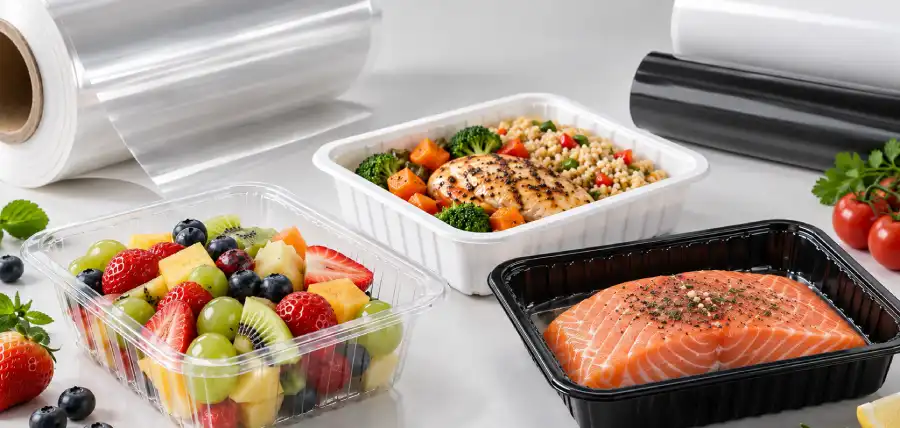
02 Start with the Food Tray Application
Buyers sometimes send an inquiry such as “We need 0.5 mm PET sheet for food trays.” That is enough to start a quotation, but it does not always tell us whether the specification is right for the finished tray.
The same nominal sheet thickness can behave very differently in a shallow salad tray, a large bakery tray and a deep meat tray. This is why material selection should start with the actual packaging application.
| Food Tray Application | Typical Starting Material | Main Sheet Considerations |
|---|---|---|
| Fresh fruit / salad tray | 宠物 / rpet | Clarity, stiffness, clean appearance, reliable forming and anti-fog if required. |
| Bakery / dessert tray | PET / RPET / PP depending on use | Product visibility, rigidity, tray geometry and storage conditions. |
| Meat / poultry tray | PET, PP or application-specific structure | Tray depth, impact resistance, sealing system, leakage control and possible barrier requirement. |
| Ready meal container | PP commonly evaluated first | Food temperature, reheating conditions, sealing compatibility and dimensional stability. |
| Frozen food tray | Depends on temperature and impact requirements | Low-temperature toughness, handling impact and storage conditions. |
| Disposable takeaway tray | PP / PS-HIPS / PET depending on use | Temperature, stiffness, transparency, cost target and lid or sealing system. |
For a broader view of where PET, PP and PS/HIPS sheet are used, see the DESU Thermoforming Application Hub 。
03 PET vs PP for Food Trays
There is no universal answer to whether PET or PP is the “better” food tray material. The correct starting point depends on how the finished tray will actually be used.
PET is usually the more natural starting point when:
- High transparency is important.
- The packed food should remain clearly visible.
- A relatively stiff tray is preferred.
- The application is mainly cold or ambient.
- RPET content is part of the packaging requirement.
- Anti-fog performance may be required.
PP deserves priority evaluation when:
- Higher filling or use temperatures are involved.
- Heat resistance matters more than maximum clarity.
- A different toughness/stiffness balance is required.
- The tray is intended for selected reheating uses.
- The existing packaging system already uses PP.
- The sealing system is designed around PP.
This is why we normally would not recommend changing from PET to PP—or from PP to PET—only because of resin price or one isolated sheet property.
A material change can also affect forming temperature, shrinkage behavior, wall distribution, finished tray rigidity and sealing performance.
04 Thickness, Tray Depth and Wall Distribution
Sheet thickness should be treated as the starting gauge before thermoforming, not as the final wall thickness of the tray.
During forming, material stretches from the flange and surrounding areas into the mold cavity. As tray depth and geometry become more demanding, wall distribution becomes increasingly important.
| Tray Condition | What It Means for Sheet Selection |
|---|---|
| Shallow, simple tray | Gauge selection is usually more forgiving because material stretch is relatively limited. |
| Deep cavity | Bottom and sidewall thinning become more important; forming behavior matters as much as nominal gauge. |
| Sharp corners or detailed geometry | Material distribution and forming window require closer evaluation. |
| Heavy packed product | Finished tray stiffness and bottom strength need to be considered. |
| Large tray footprint | Overall rigidity can become critical even when cavity depth is moderate. |
It is more useful to provide the current gauge together with tray length, width and depth. If an existing tray already works well, its current material and sheet specification are usually the best starting benchmark for a new supplier trial.
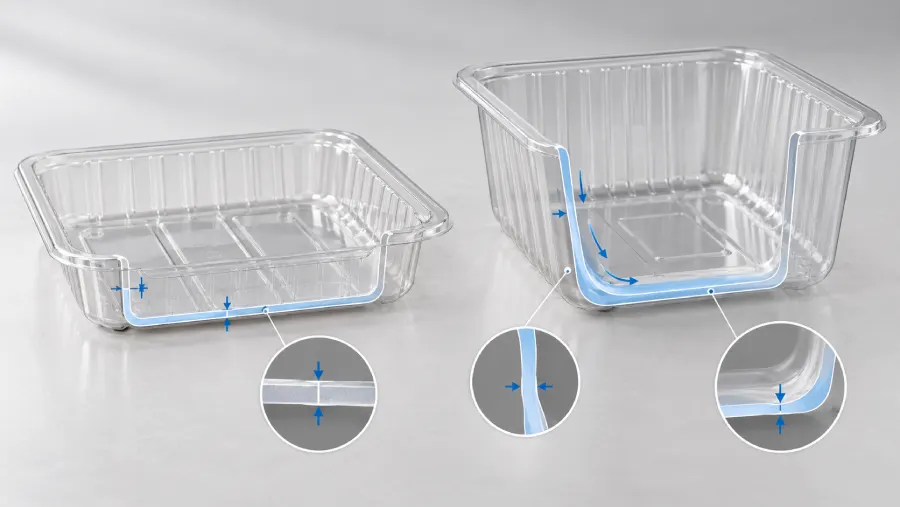
A thicker sheet is not always the first solution
Thin corners, weak bottoms, whitening or uneven sidewalls can result from the interaction between the sheet, heater profile, mold geometry and forming conditions.
Increasing sheet gauge can sometimes improve strength, but if the real problem is uneven material distribution, using more material may increase cost without fully solving the forming issue.
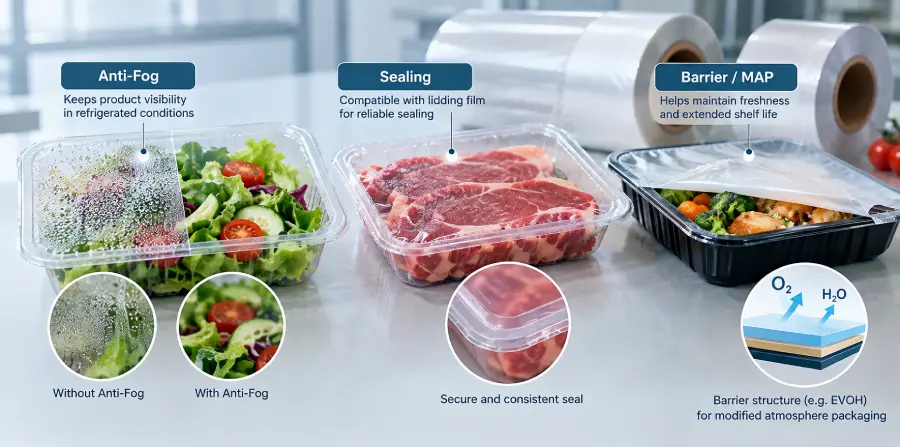
05 Anti-Fog, Sealing and Barrier Requirements
These requirements should be confirmed separately. They are not automatically necessary for every food tray.
防雾
Anti-fog PET sheet can be useful when condensation would obstruct product visibility, especially in selected refrigerated fresh-food packaging.
If visibility through the tray is not important, anti-fog treatment may provide little practical value.
热封
If the tray will be sealed with lidding film, tell us the actual sealing system rather than requesting only “food tray sheet.”
Sheet, tray flange, sealing layer and lidding film must work as one packaging system.
Barrier / MAP
Standard mono-material sheet is not automatically suitable for every shelf-life requirement.
Applications requiring stronger oxygen barrier may require an EVOH-containing multilayer sheet structure.
表面 & 外貌
Clarify whether the project needs high transparency, natural PP, opaque or colored sheet, smooth surface, matte appearance or another visual requirement.
Roll width should match the thermoforming layout
Roll width directly affects material utilization. The correct width depends on mold layout, edge trim allowance and the feeding configuration of the thermoforming line.
For an existing mold, providing the current roll width is normally the simplest route. For a new project, tray drawings and mold layout are more useful than simply asking for the maximum sheet width available.
06 Approving a New Food Tray Sheet
For a new tray, material change, gauge-reduction project or supplier change, sheet should ideally be approved through an actual thermoforming trial rather than flat-sheet inspection alone.
Food type, temperature, tray geometry, sealing and functional requirements.
Material, thickness, width, color, surface and coating or barrier requirements.
Use the actual machine, mold and practical production conditions where possible.
Check wall distribution, stiffness, flange, clarity, stacking, sealing and handling.
07 What to Include in a Food Tray Sheet RFQ
A quotation does not require a complicated technical document. The following information is normally enough for us to understand the project much faster.
Current or preferred material: PET / RPET / PP / PS / HIPS / not decided
Sheet thickness: ___ mm
Roll width: ___ mm
Tray dimensions: ___ × ___ × ___ mm
Food / packed product: ___
Filling / use temperature: ___ °C
Appearance: clear / natural / opaque / colored
Sealing: yes / no / not decided
Anti-fog: required / not required / not decided
Barrier / MAP: required / not required / not decided
Current issue: thinning / cracking / poor clarity / sealing / stiffness / other
Estimated demand: ___
If you already have a working tray and current sheet specification, sending the existing specification or tray drawing is usually the fastest way to start.
08 FAQ — Thermoforming Sheet for Food Trays
Is PET or PP better for thermoformed food trays?
Neither is universally better. PET is commonly selected when clarity and stiffness are priorities, while PP is often evaluated when higher temperature resistance or a different toughness profile is required.
What thickness PET sheet should I use for a food tray?
There is no single standard thickness for all trays. Required gauge depends on tray footprint, depth, draw ratio, product weight, stiffness target and thermoforming conditions.
Can I reduce sheet thickness to lower packaging cost?
Sometimes, but gauge reduction should be validated on the actual mold. The finished tray still needs sufficient wall distribution, rigidity, flange quality and handling strength.
When does a food tray need anti-fog sheet?
Anti-fog is mainly useful when condensation would reduce visibility of the packed product, such as selected refrigerated fresh-food applications.
Can standard PET sheet be used for MAP food trays?
It depends on the required shelf life and barrier performance. Applications requiring stronger oxygen barrier may need a multilayer barrier sheet structure.
Do you manufacture finished food trays?
No. DESU manufactures thermoforming plastic sheet and sheet rolls for packaging manufacturers and thermoforming factories. Our customers use the sheet to produce the finished food packaging.
Can DESU provide sheet for production trials?
Sample and trial specifications can be discussed according to the project. For a new tray, the most useful validation is normally a thermoforming trial using the intended mold and production conditions.
Have a Food Tray Project?
Send us your tray dimensions or drawing, current material and thickness, food temperature, sealing requirements and any forming problem you are trying to solve. We can help narrow the sheet specification before trial.