How to Choose Thermoforming Sheet for Food Trays: PET, PP or PS/HIPS
A practical guide from a thermoforming sheet manufacturer on material selection, temperature, forming depth, sheet thickness, roll width and functional requirements for food tray production.
01 PET, PP or PS/HIPS: Start With the End-Use Conditions
When a buyer asks us which plastic sheet is suitable for a food tray, the material name alone is rarely enough to recommend a reliable specification.
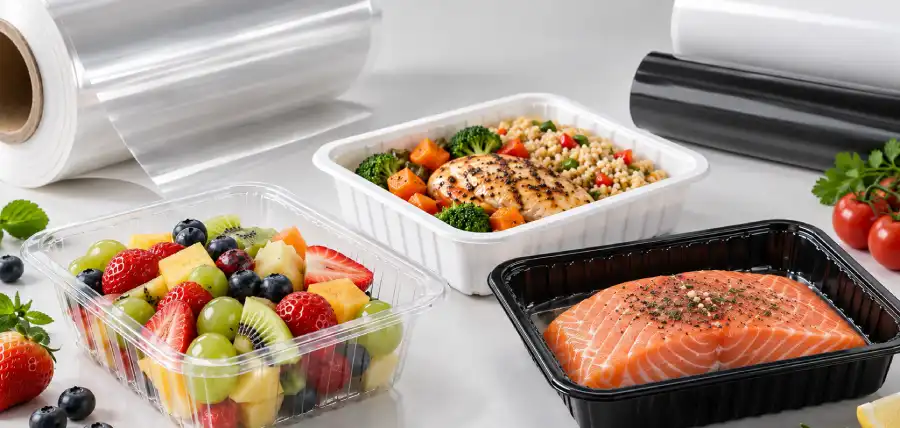
PET, PP and PS/HIPS can all be used for thermoformed food packaging, but they suit different combinations of transparency, temperature, rigidity, impact performance and processing requirements.
The better starting questions are what food will be packed, whether the tray will be used at room temperature, refrigerated, frozen or heated, how deep the tray is, and whether sealing, anti-fog or barrier performance is required.
| วัสดุ | Typical Reasons to Consider It | What to Confirm |
|---|---|---|
| APET - rpet | High clarity, good stiffness and product visibility for many ambient and refrigerated food trays. | Tray depth, transparency, recycled content, sealing structure and anti-fog requirements. |
| PP | Useful where temperature performance, low density or specific hot-food applications matter. | Use temperature, rigidity, forming depth, sealing system and filling conditions. |
| PS / HIPS | Often considered for opaque or colored trays, dairy applications and some refrigerated or frozen food packaging. | Low-temperature performance, impact requirement, color, rigidity and final tray geometry. |
02 Temperature Can Change the Material Decision
Storage and use temperature can affect both material selection and grade selection. A material that works well for an ambient tray should not automatically be assumed suitable for refrigerated, frozen or heated packaging.
Low-temperature impact performance becomes more important.
Rigidity and forming stability must remain suitable after cooling.
Standard grades can often provide a suitable starting point.
Temperature resistance and the correct material grade become critical.
For refrigerated food, the formed tray still needs suitable stiffness and impact performance after cooling. Frozen applications may put greater pressure on low-temperature toughness, especially during stacking, transport and handling.
PP and PS/HIPS are available in grades for different temperature conditions, while PET-based structures are widely used for many chilled and fresh-food applications where clarity and rigidity are important.
03 Tray Depth Matters More Than the Nominal Sheet Thickness
One specification mistake we often see is starting with a number such as “0.5 mm PET” before considering the geometry of the finished tray.
During thermoforming, the sheet stretches and redistributes. A deeper cavity generally requires more material redistribution than a shallow tray. The bottom, sidewalls and corners can therefore finish with very different wall thicknesses even when the starting sheet gauge is the same.
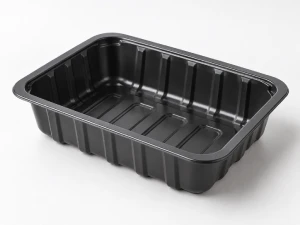
 Shallow Tray
Less material redistribution.
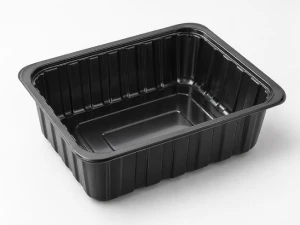
 Medium Depth
Moderate material stretching.
 Deep Tray
Greater redistribution during forming.
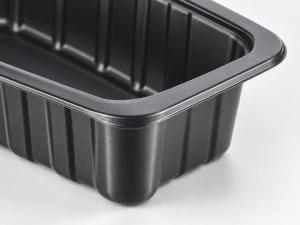 Corners
Often a critical area for wall thickness.
- tray length and width;
- การขึ้นรูปความลึก
- corner radius;
- minimum acceptable wall thickness;
- sheet material;
- mold layout;
- forming process and machine conditions.
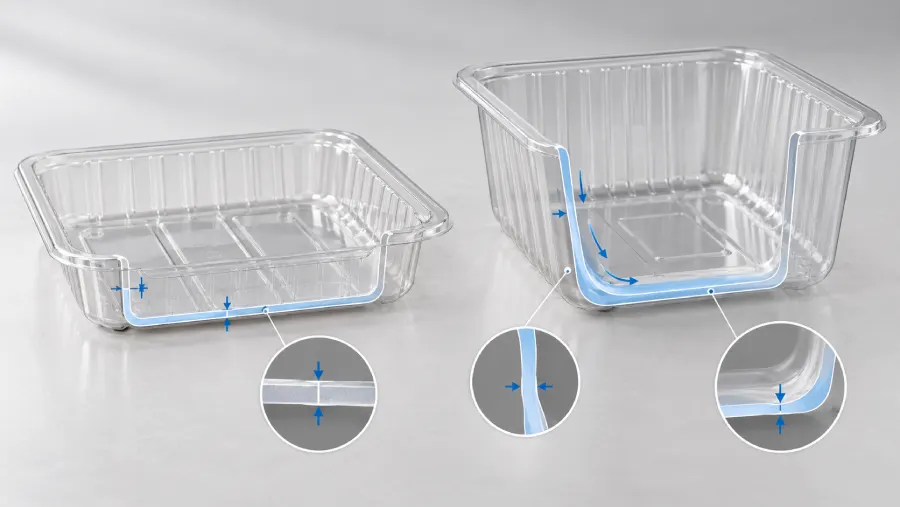
Increasing the starting sheet thickness is not always the best first correction. Heating, material distribution and forming conditions may also need to be checked before changing the sheet specification.
04 Roll Width Should Be Defined From the Mold and Machine
Thickness usually receives most of the attention in a sheet RFQ, but roll width is equally important for actual production.
The preferred sheet width should normally be determined from the mold layout, number of cavities, product arrangement, trimming allowance and machine feeding width.
If an existing tray is already running successfully, the current roll specification is normally the easiest starting reference. For a new project, a mold layout or tray drawing gives a sheet manufacturer much more useful information than simply asking for a standard roll width.
05 Do You Need Anti-Fog, Sealing or a Barrier Structure?
Anti-Fog
Anti-fog treatment is mainly useful when condensation affects product visibility or package appearance, especially in refrigerated fresh-food applications.
It does not need to be added to every food tray specification. If condensation is not a real packaging problem, adding anti-fog only makes the specification more complicated.
การปิดผนึกด้วยความร้อน
If the tray will be sealed with a lidding film, the sealing system should be discussed before the sheet structure is finalized.
Sheet material, sealing layer, lidding film and sealing conditions need to work together. Some applications may therefore need a laminated structure instead of a standard mono sheet.
Barrier Packaging
Fresh meat, fish, cheese and modified-atmosphere packaging can require higher oxygen or moisture barrier performance.
In these projects, the question is no longer simply PET versus PP. Shelf-life requirements, gas environment and sealing structure can determine whether a multilayer solution such as PET/EVOH/PE barrier sheet should be evaluated.
For chilled produce, meat or ready-to-eat food, you can also read our guide on selecting PET sheet for fresh food and ready-to-eat packaging -
06 What Information Should You Send a Sheet Manufacturer?
A useful RFQ does not need to be complicated, but it should give the sheet manufacturer enough information to understand what will actually be thermoformed.
- type of food being packed;
- ambient, refrigerated, frozen or heated use;
- tray length, width and depth;
- current material and thickness, if already in production;
- required transparency or color;
- roll width or machine feeding width;
- mold layout, if available;
- sealing requirement;
- anti-fog requirement;
- barrier requirement;
- destination market and required food-contact documentation.
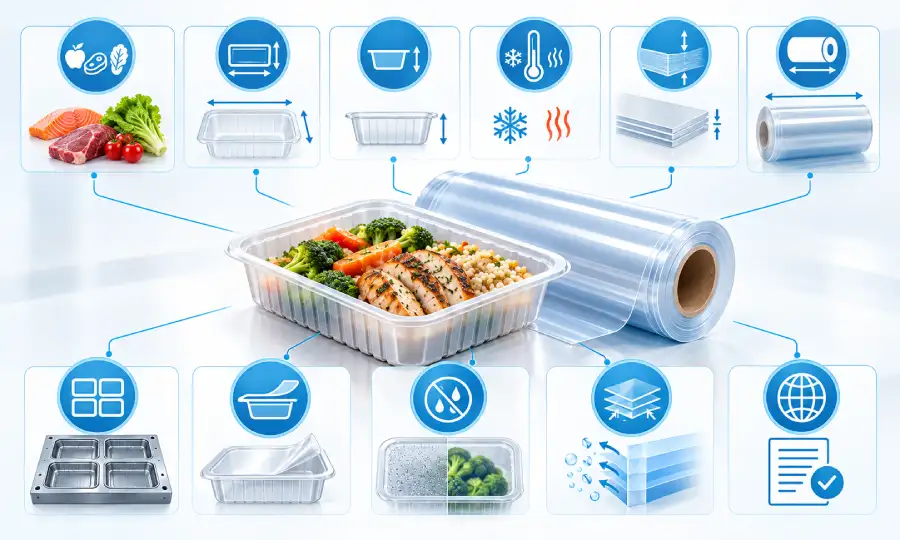
For an existing production line, the current sheet specification or a sheet sample is usually a useful reference.
For a new project, a tray drawing, formed sample or mold information can tell us much more than a generic request for “food-grade plastic sheet.”
07 Different Food Trays Need Different Sheet Specifications
Fruit trays, bakery trays, fresh-meat trays, frozen-food trays and ready-meal containers may all be classified as food packaging, but that does not mean they should use the same thermoforming sheet.
A clear fruit tray may prioritize transparency and stiffness. A frozen-food tray may place more emphasis on low-temperature behavior. A ready-meal container may require greater temperature resistance, while a fresh-meat tray may introduce additional sealing and barrier requirements.
That approach gives a much more useful sheet specification than choosing PET, PP or PS/HIPS from the product name alone.
For other packaging applications, continue through the DESU Application Hub -
08 คำถามที่พบบ่อย
Which plastic sheet is best for thermoformed food trays?
There is no single best material for every tray. PET is commonly considered where clarity and stiffness matter, PP where temperature-related performance is important, and PS/HIPS for certain opaque, refrigerated, frozen or application-specific trays.
How do I choose the sheet thickness for a food tray?
Start from the material, tray dimensions, forming depth, geometry and required final wall thickness. The nominal starting gauge alone does not determine the wall thickness of the finished thermoformed tray.
Can the same sheet specification be used for chilled and frozen food?
Not automatically. Low-temperature use can change impact, rigidity and handling requirements, so the actual storage and transport conditions should be confirmed first.
Does every refrigerated food tray need anti-fog sheet?
No. Anti-fog is mainly useful when condensation affects package visibility or appearance. It should be selected according to the real packaging condition.
What should I provide when requesting custom food tray sheet?
Useful information includes tray dimensions, forming depth, food type, use temperature, material preference, current sheet thickness if available, roll width, sealing requirements and any anti-fog or barrier requirements.
Need a Sheet Specification for Your Food Tray?
Send us your tray dimensions, forming depth, application temperature and current sheet specification. DESU can help evaluate the material, thickness, width and functional requirements for your thermoforming sheet.
Discuss Your Project