Thermoforming Sheet Selection Guide
PET or PP Sheet for Thermoformed Cups and Lids?
Choose PET or PP thermoforming sheet for cups and lids by draw, rim fit, gauge, roll width, clarity, temperature, sealing and line trials.
01Separate the cup specification from the lid
A buyer may send us a drawing set labeled “cup and lid” and ask for one PET or PP sheet recommendation. From a thermoforming sheet manufacturer’s perspective, that request contains two different forming jobs. The cup creates its performance through side walls, bottom geometry and stacking. The lid depends more heavily on rim definition, fit, denesting and the chosen closure or seal. One resin family may be considered for both, but that does not mean one gauge, surface or process window will serve both parts.
Before discussing material, identify which component is being sourced, how it will be formed and which failure would reject it. A cup can look clear and still fail because the wall is too thin or the stack jams. A lid can form completely and still fail because its rim does not fit consistently after trimming and handling.
Cup: depth and stack behavior
Define draw depth, bottom and corner radii, side-wall distribution, rim stiffness, stacking pitch, release and fill conditions. State whether the cup must show the product clearly and how it will be handled after filling.
Lid: rim accuracy and closure
Define rim profile, snap or seal function, dimensional tolerance, denesting, hinge or tab details, transparency, lidding interface and the conditions under which fit will be checked.
This split should remain visible in the RFQ. If both parts are in scope, provide separate drawings and a separate acceptance list for each one. That prevents a strong result on the cup from hiding an unresolved lid problem.
02Choose PET or PP from the application
The material decision should follow the finished part, forming conditions, temperature exposure, clarity and stiffness needs, and downstream work. Material names alone do not tell a sheet producer which grade, structure or surface will run on the customer’s line.
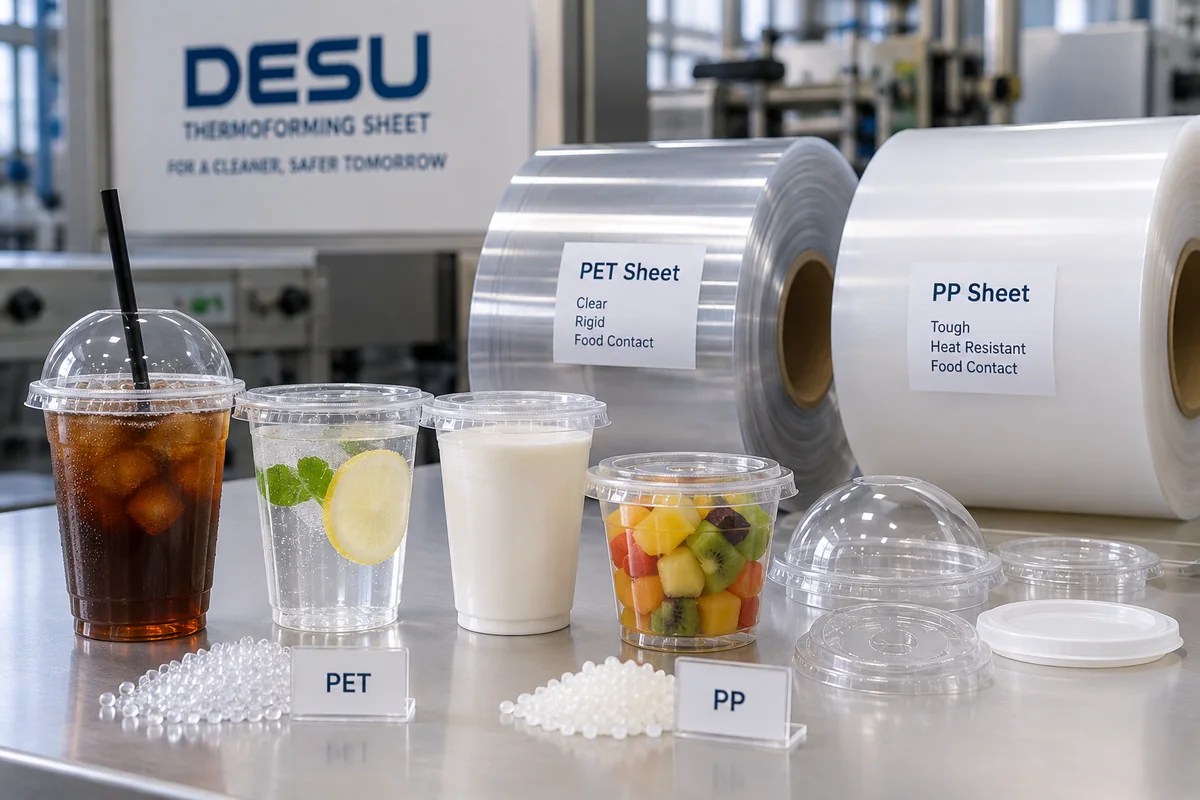
PET熱成形シート is a practical starting route when high visual clarity and a crisp, rigid presentation rank near the top of the buyer’s list. The project still needs to confirm sheet condition, gauge, heating uniformity, draw, rim definition and compatibility with any printing, bonding or sealing step.
PP熱成形シート deserves priority when toughness and the actual filling, storage or use-temperature conditions point in that direction. PP selection should still be tied to required stiffness, dimensional control, shrink behavior, forming window and closure performance. “Heat resistant” is not a complete grade specification, and it should not replace trials under the intended temperature cycle.
| Decision input | When PET is a strong starting point | When PP is a strong starting point |
|---|---|---|
| 外観 | The buyer prioritizes clear display and a rigid visual presentation | Clarity is secondary to the PP grade’s fit with the functional requirements |
| 温度 | The verified application cycle fits the selected PET sheet and formed part | The filling or use cycle supports evaluation of a PP route |
| Forming | The tool, draw and heating arrangement can produce the required wall and rim | The line can control PP heating, draw, shrink and dimensional behavior |
| Approval | The formed cup or lid passes the same drawing, fit, stacking, sealing and handling tests used for production approval | |
Clarify appearance, temperature, stiffness, toughness, fit and seal priorities.
Select PET or PP and define the exact sheet and roll assumptions.
Compare measured results by cavity under recorded line settings.
03Build the cup specification around the draw
Cup depth makes wall distribution central to the sheet decision. Send the opening diameter, total depth, bottom profile, side-wall draft, corner radii, rim and any ribs or decoration that influence draw. Also identify where the finished cup needs a minimum wall or stiffness. Starting gauge should be chosen to protect these critical areas after forming, not simply copied from another cup with a similar capacity.
Stacking requirements deserve their own acceptance criteria. State the desired stack pitch, how cups must release, and whether the line has experienced blocking, leaning stacks or inconsistent feeding. If the thermoformer uses several cavities, inspect stacking and wall distribution by cavity. Averages can hide one position that repeatedly forms thin or produces a distorted rim.
Fill and storage conditions affect the material discussion. Give the sheet supplier the real product temperature at filling, later storage conditions and any transport exposure. Do not substitute a broad label such as “cold cup” or “hot cup” for that cycle. The supplier can use the conditions to guide the trial, but the buyer remains responsible for approving the finished package under its intended use.
- Does the wall remain acceptable at the deepest and sharpest areas?
- Does the rim stay consistent enough for the downstream lid or seal?
- Do formed cups stack, release and feed at the required speed?
- Does appearance remain acceptable after forming and handling?
04Build the lid specification around rim and fit
A lid usually has less draw than a cup, but small dimensional changes at the rim can have a large effect on fit. Provide the mating cup or its controlled rim dimensions, the closure type and the force or handling behavior the buyer expects. State whether the lid snaps on, seals to the rim, combines both functions or is only a thermoformed insert.
Denesting must be assessed after forming, trimming, stacking and storage. A lid that separates by hand at the sample table may behave differently in an automatic line. Identify the feeder, line speed and failure mode. If sticking or double-picking occurs, review geometry, trim, surface, static behavior, sheet condition and machine settings together.
Transparency and color should be specified as acceptance requirements rather than general preferences. PET is commonly shortlisted for a clear lid, but the buyer should define what is being inspected through it and whether marks, haze or color variation are critical. PP may be selected for a lid when its functional balance fits the temperature and closure requirements. The existing PET cold-drink cup-lid sheet そして PP cup-lid sheet pages are useful application references. They do not replace approval against the buyer’s rim and line.

05Convert the tool into gauge and roll requirements
Thickness should follow material, part geometry, depth and required final wall distribution. Roll width should follow mold layout, trim and machine feed. These decisions are connected. A buyer can select a suitable resin and still receive an inefficient roll if the supplier does not have the cavity layout, edge allowance and unwinder limits.
DESU’s public anti-block PET range is 0.18–1.7 mm thick and 250–1400 mm wide. The public normal PP range is 0.3–2.0 mm thick and 300–900 mm wide, with the exact available range depending on grade. These are manufacturing capability ranges, not automatic recommendations for a particular cup or lid. The project gauge must come from the formed-part target and trial.
Specify nominal gauge and the tolerance method the buyer will use. Identify where thickness is measured, how many readings are required and how variation will be related to forming results. For the roll, specify nominal width and tolerance, winding direction, core, maximum roll diameter or weight if the machine imposes a limit, edge and splice requirements, and packaging needed for storage and transport.
Send a tool-layout drawing where possible. It should show cavity count across the web, pitch, trim lines and feed direction. This allows the supplier to review width without guessing from the finished part dimensions. It also makes material-yield comparisons more meaningful because each proposal uses the same layout assumptions.
06Define clarity, surface and sealing tests
Surface requirements affect feeding and downstream operations. DESU produces PET anti-block sheet through silicone-oil-coated and embedded anti-block routes. The buyer should state whether the sheet or formed part will be printed, bonded or sealed and which side performs that operation. A treatment that helps sheet separation should not be assumed suitable for every downstream process.
For clarity, agree whether inspection applies to flat sheet, formed cup or lid, or both. Forming can redistribute material and change the appearance of deep or highly stretched areas. Use an approved sample and controlled inspection conditions when appearance is important. Color requirements should likewise identify the material, target and permitted variation rather than rely on a description such as “natural” or “transparent.”
For sealing, give the supplier the mating film, lid or cup material, sealant layer, sealing equipment and operating window. State whether the closure must be peelable or permanent and how the seal will be judged. A good flat-sheet surface does not prove that a formed rim will seal consistently. Rim geometry, formed thickness, contamination control, temperature, pressure and dwell conditions belong in the package trial.
07Approve line performance before changing suppliers
Sheet price cannot be separated from line performance. Unstable feeding, thin cup walls, poor lid definition, difficult denesting or inconsistent sealing can consume more value than a small difference in price per kilogram. Run the candidate roll on the intended machine and keep a record that the sheet manufacturer and thermoformer can use.
Minimum forming-trial record
- Material, grade or structure, batch, gauge, width and roll direction
- Storage and conditioning before the trial
- Machine, tool, heater settings, line speed and trim setup
- Results by cavity for wall, rim, fit, stacking, denesting and appearance
- Seal conditions and result when a closure is part of the project
- Photos or samples tied to the recorded condition and defect location
Cracking, whitening or incomplete forming can involve heating, temperature uniformity, draw, mold geometry, material condition or the sheet specification. Curl and feeding problems can involve residual stress, winding, storage, temperature change, handling or machine settings. Diagnose the pattern before assigning the cause. Change one major variable at a time.
When changing suppliers, use the current successful sheet as the baseline. Compare structure, tolerance, roll dimensions, forming behavior and documentation without changing material, gauge and settings at the same time. DESU’s production approach includes online and offline inspection, batch quality checks and traceability. The useful buyer requirement is to connect those records to the agreed sheet specification and retained approval sample.
A verified DESU record covers 18 metric tons of PP plastic sheet rolls shipped to Indonesia for thermoforming coffee cup lids. It confirms a real PP cup-lid application. It does not prove that the same grade, gauge or settings will suit another lid, so each new tool still requires its own approval.
08Send an RFQ that can be quoted and trialed
Cups and lids sheet RFQ
- Part: cup, lid or both, with separate drawings and current samples
- Use conditions: product, filling temperature, storage, transport and later heat exposure
- Material decision: PET, PP or an open comparison, with the priority behind the choice
- Cup requirements: depth, draft, radii, minimum wall, rim, stack pitch and release
- Lid requirements: rim profile, mating cup, closure, fit, trim and denesting
- Sheet: gauge, tolerance and measurement method, clarity or color, surface and treated side
- Roll: width, tolerance, direction, core, diameter or weight limit, edge and splice rules
- Seal: mating material, sealant layer, equipment, operating window and acceptance method
- Process: thermoforming machine, tool layout, heating arrangement, speed and known defects
- Compliance: destination market and documents required for the exact grade and structure
- Approval: trial quantity, test plan, reject criteria and retained reference sample
Mark missing items as open questions instead of inserting assumed values. A sheet supplier can then separate what is needed for quotation from what must be closed before production approval.
09Buyer questions before ordering sheet
Can a cup and its lid use the same PET or PP sheet specification?
They can in some projects, but the buyer should not assume it. Cup draw and stacking differ from lid rim, fit and denesting requirements. Approve each component against its own drawing and acceptance tests.
Does PP automatically solve a high-temperature requirement?
No. State the full filling, storage and use cycle, then validate the selected PP grade, formed geometry and closure under those conditions.
Is a tighter sheet-thickness tolerance always better?
The tolerance must support the formed-part requirement and be defined by an agreed measurement method. An unnecessarily tight number can complicate sourcing without addressing tool or heating variation.
What should be fixed before comparing supplier prices?
Fix the part drawing, material or comparison basis, gauge and width assumptions, roll format, surface, closure, trial method and acceptance criteria. Otherwise, the quotations may describe different products.