熱成形シート選択ガイド
ブリスター包装用プラスチックシートの選び方
Select PET, PETG or PS/HIPS sheet for blister packaging by cavity depth, clarity, protection, gauge, surface, sealing, tooling and RFQ data.
01Start with the packed product and closure
A blister-sheet inquiry is incomplete until the packed product, cavity geometry and closure method are known. A clear retail blister, an insert tray and a medical application may all use thermoformed cavities, but their needs for clarity, impact behavior, cleanliness, sealing and documentation are not interchangeable.
DESU supplies thermoforming sheet and roll. We do not select the finished pack on the buyer’s behalf, but we can translate the approved package design into material, gauge, width, surface and roll requirements that can be produced and trialed.
02Shortlist PET, PETG or PS for the required cavity
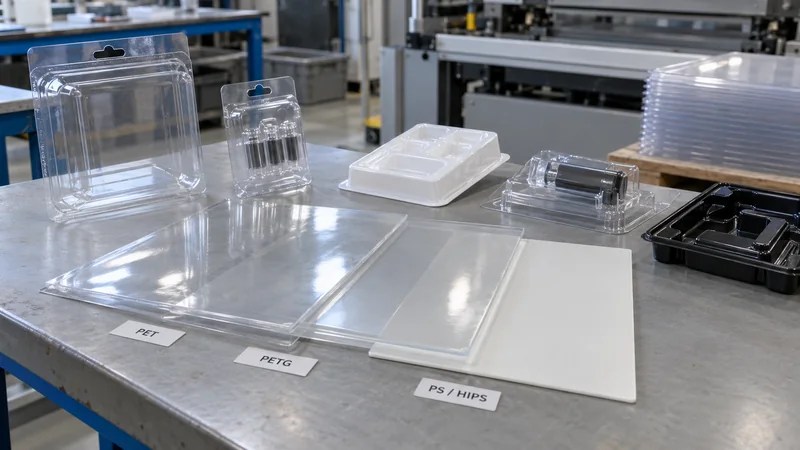
ペットシート、 含む APETシート, is a practical starting point when a blister needs clear product visibility, good rigidity and a clean retail presentation. Buyers should still confirm draw depth, closure compatibility and any impact or barrier requirement rather than selecting PET from appearance alone.
PETG is worth considering when a clear part has demanding cavity detail or deeper geometry and the forming trial shows that the proposed PET grade does not provide a comfortable process window. It can also be evaluated where toughness and forming response matter more than maximizing rigidity. The decision should compare formed-part clarity, wall distribution, closure performance and total specification cost on the actual tool.
PS and HIPS are useful candidates when transparency is unnecessary. Colored retail blisters, protective hardware trays, inserts and component trays may favor an opaque sheet with a practical stiffness-and-impact balance. HIPSシート is especially relevant when the formed part needs more handling toughness than a general-purpose PS option. Color, surface finish and the weakest formed wall should be agreed before approval.
| Decision | Questions to resolve |
|---|---|
| Visibility | Must the customer inspect the product through the cavity? |
| Draw | How deep is the cavity, and where will thinning concentrate? |
| Protection | What stiffness and impact behavior does the packed product require? |
| Closure | Heat seal, card, lidding film, snap fit or another system? |
| プロセス | Which machine, tool and heating arrangement will form the sheet? |
| Blister application | Sheet-selection focus |
|---|---|
| Retail display blister | Clarity, gloss, flange consistency and compatibility with the selected card or lidding system. |
| Hardware or tool blister | Impact resistance, cavity support, corner thickness and stiffness for the packed weight. |
| 電子機器のパッケージング | Part protection, dimensional consistency and any specified antistatic or ESD performance. |
| Medical or precision tray | Formed detail, cleanliness, tolerance, closure compatibility and required material documentation. |
The DESU article on common blister plastic sheets can support the initial shortlist. It should not replace a project-specific forming and sealing trial.
03Choose starting gauge from the deepest and weakest areas
Thickness should be derived from material, geometry, depth and required final wall distribution; roll width should consider mold layout, trim and machine feed.
Review depth-to-opening relationship, corner radii, draft, flange and any narrow channels. The goal is not simply a thick starting sheet; it is acceptable wall distribution after forming. If thin corners appear, investigate heating zones, plug or tool design, material condition and starting gauge as one system.
A deeper cavity with a small opening usually asks more of the sheet than a shallow cavity with the same footprint. Tight corner radii can concentrate stretch, so the buyer should identify the minimum acceptable wall at corners, sidewalls and the cavity base. Starting gauge is then selected as a trial value that can deliver those formed-wall targets without adding unnecessary material.
Final wall distribution also depends on how the sheet is heated and presented to the tool. Zone balance, mold geometry and plug assist can redirect material before it reaches the deepest area. For a useful supplier discussion, share the opening dimensions, depth, radii, tool layout and whether plug assist is available together with the proposed starting gauge.

04Match surface and structure to sealing and presentation
Surface treatment may support anti-block performance, feeding, printing or bonding, but these functions are not interchangeable. Identify the side that will contact the sealing or printing process. For multilayer options, define what the structure is expected to do and how it will be validated.
For PETG, APET and GAG comparisons, see the guide to PET-family blister sheet structures. The procurement decision should still return to the required cavity, closure, appearance and forming process.
05Diagnose forming problems before changing the sheet
Cracking, whitening or poor forming may come from heating, temperature uniformity, draw depth, mold geometry, material condition or specification; do not assume sheet defect first.
Record the location and pattern of the defect. Whitening isolated to deep corners suggests a different investigation from random marks across the web. Compare cavity positions and roll direction, then change one major variable at a time. This protects the buyer from replacing a valid sheet when the root cause is elsewhere in the forming system.
06Give the sheet producer a complete blister RFQ
Blister sheet RFQ checklist
- Packed product and application category
- Part drawing, cavity depth, radii, flange and closure
- Clarity, color, stiffness and impact priorities
- Preferred PET, PETG, PS/HIPS or approved comparison materials
- Starting gauge, tolerance, roll width, winding direction and core
- Surface, printing, bonding, sealing or barrier requirements
- Machine, mold, heating arrangement and trial acceptance method
07Buyer questions before material approval
Should I choose PET or PETG for a clear blister?
Begin with the required visibility, rigidity, cavity detail and closure system. PET is a common clear, rigid starting point; PETG is worth trialing when deeper or more detailed forming requires a different forming response. Approve the choice on the real tool.
When is HIPS more suitable than PET?
Consider HIPS when the blister or tray can be opaque or colored and needs a useful balance of stiffness, impact behavior and forming performance. Confirm the weakest formed wall and handling requirement rather than comparing unformed samples alone.
How should starting thickness be selected for a deeper cavity?
Use cavity depth, opening dimensions, corner radii and the minimum required formed wall as the starting inputs. Heating balance, tooling and plug assist should then be included in the trial before finalizing gauge.
What should I provide when requesting a blister-sheet quotation?
Provide the packed product, drawing, cavity dimensions, closure method, material preference, clarity or color target, starting gauge, roll width, surface needs, machine and trial requirements.