✅ Quick Answer
PET sheet roll is ideal for automatic thermoforming production with high efficiency, while PET sheet (cut sheets) is better suited for manual forming or small-scale production. The best choice depends on your production method, equipment, and application.
What Is the Difference Between PET Sheet Roll and Sheet?
PET sheet is available in two main formats:
- Roll (continuous form)
- Sheet (cut pieces)
The material itself is similar, but the processing method and usage scenarios are very different.
👉 In summary: The choice is not about material, but about production efficiency and application.
PET Sheet Roll vs Sheet Comparison Table
| Característica | Rollo de lámina de PET | PET Sheet (Cut Sheet) |
|---|---|---|
| Production Type | Automatic thermoforming | Manual / semi-auto |
| Efficiency | Alto | Bajo |
| Cost per unit | Más bajo | Más alto |
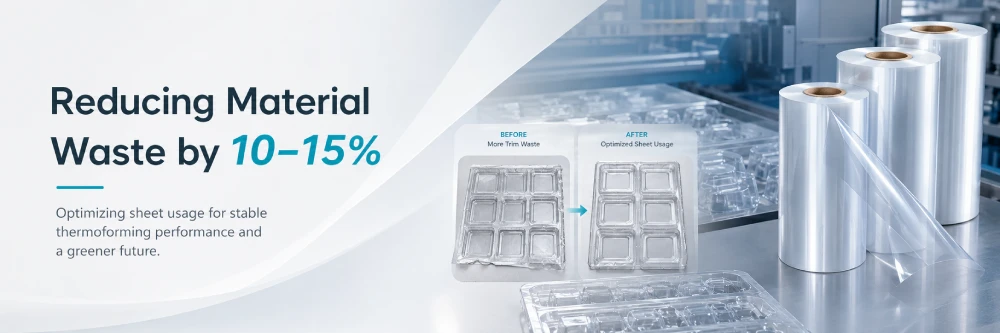
| Material Waste | Less | More |
| Flexibilidad | Más bajo | Más alto |
| Solicitud | Mass production | Small batch / custom |
🔍 When to Choose PET Sheet Roll
PET sheet roll is best for:
- fully automatic thermoforming machines
- large-scale packaging production
- continuous forming processes
Ventajas:
- higher production efficiency
- lower labor cost
- better material utilization
👉 In summary: PET sheet roll is ideal for industrial-scale thermoforming.
🔍 When to Choose PET Sheet (Cut Sheet)
PET cut sheets are suitable for:
- manual thermoforming
- prototyping
- small batch production
Ventajas:
- easy to handle
- flexible usage
- no need for roll feeding equipment
👉 In summary: PET sheet (cut sheet) is better for flexibility and small production runs.
⚠️ Key Factors to Consider Before Choosing
1. Production Volume
- High volume → roll
- Low volume → sheet
👉 In summary: Production scale determines the format.
2. Equipment Type
- Automatic thermoforming machine → roll
- Manual or semi-auto → sheet
👉 In summary: Your machine setup decides your material format.
3. Cost Efficiency
- Roll → lower long-term cost
- Sheet → higher material and labor cost
👉 In summary: Rolls are more cost-effective for mass production.
4. Material Handling
- Rolls require feeding systems
- Sheets are easier to store and handle
👉 In summary: Sheets offer convenience, rolls offer efficiency.
5. Application Type
- Food packaging → mostly roll
- Custom packaging → often sheet
👉 In summary: Application defines the best format.
🏭 Factory Insight (15 Years Experience)
From real production experience:
- Over 80% of large factories use Hoja de mascotas
- Many small buyers start with sheets, then switch to rolls
- The biggest mistake is choosing sheets for mass production
👉 In summary: Roll is the long-term solution for serious production.
Procurement Guide
When sourcing PET sheet, ask:
- Do I have automatic forming equipment?
- What is my monthly production volume?
- Do I need flexibility or efficiency?
Recommended Strategy:
- Start small → use sheet
- Scale production → switch to roll
👉 In summary: Choose based on your growth stage.
Cost vs Efficiency Analysis
- Roll:
- higher initial setup
- lower long-term cost
- Sheet:
- lower entry barrier
- higher long-term cost
👉 Optimal strategy:
Use roll for scalability, sheet for flexibility
Preguntas frecuentes
Q1: Which is better, PET sheet roll or sheet?
A: Roll is better for mass production, while sheet is better for small-scale or manual processes.
Q2: Can PET sheet roll be used for manual thermoforming?
A: It is possible but not practical due to handling difficulty.
Q3: Why is PET sheet roll more cost-effective?
R: Reduce el costo de mano de obra y el desperdicio de material en la producción a gran escala.
P4: ¿Existe alguna diferencia de calidad entre el rollo y la hoja?
R: No. El material es el mismo; sólo el formato difiere.
P5: ¿Debo cambiar de hoja a rollo?
R: Sí, si su volumen de producción aumenta y utiliza equipos automatizados.
Conclusión final
La elección entre rollos y láminas de PET depende de la escala de producción, el equipo y la aplicación. Para el termoformado a gran escala, el rollo es la opción más eficiente y rentable, mientras que la lámina es adecuada para flexibilidad y pequeñas necesidades de producción.