دليل تطبيق التشكيل الحراري PET
PET or RPET for Fruit Packaging Boxes: What Buyers Should Check
Clear fruit packaging boxes require consistent transparency, reliable thermoforming and suitable moisture management. For packaging converters, choosing between virgin APET and RPET involves more than recycled content or material price. Sheet appearance, thickness, forming performance and package design must also be considered.
01 What Does Fruit Packaging Require from PET Sheet?
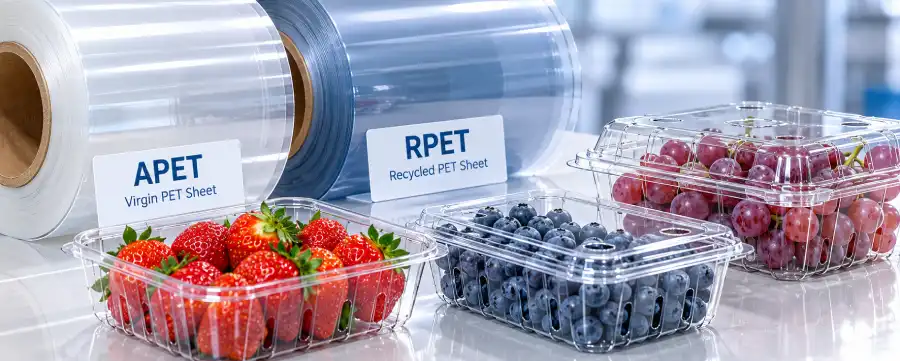
Transparent thermoformed boxes are widely used for strawberries, blueberries, grapes, cherries and other fresh fruits. Clear packaging allows consumers to inspect the produce while providing a defined structure for transportation, handling and retail display.
The sheet specification should begin with the intended packaging format. A shallow fruit tray and a deeper hinged clamshell may need different starting thicknesses, formed-wall distribution and stiffness.
Before choosing PET or RPET, buyers should establish several application requirements:
- الشفافية: Consistent clarity with acceptable haze, tint, surface marks and visible inclusions.
- Forming performance: Suitable material distribution for the required forming depth and box geometry.
- Mechanical performance: Adequate finished-part stiffness for fruit weight, stacking and handling.
- Ventilation compatibility: Reliable forming and punching around ventilation openings.
- Moisture and visibility: Appropriate surface performance under expected refrigeration and temperature changes.
- Food-contact requirements: Suitable documentation for the intended application and destination market.
These requirements help determine the material construction, starting gauge, surface treatment and roll specifications needed for production.
02 Virgin APET vs RPET for Fruit Packaging Boxes
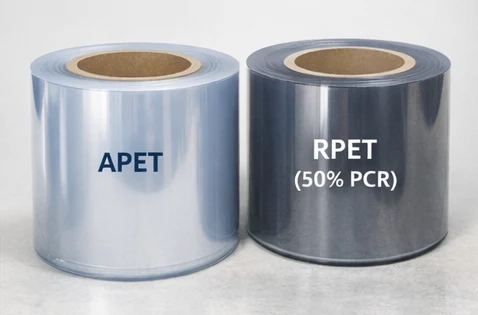
Virgin APET and RPET both belong to the PET material family. Virgin APET sheet is produced from virgin PET raw material, while RPET incorporates recycled PET.
Both materials can provide suitable clarity and rigidity for transparent thermoformed fruit packaging. Their main purchasing differences concern recycled content, visual consistency, sourcing requirements and sheet construction.
| Selection Factor | Virgin APET Sheet | ورقة rpet |
|---|---|---|
| الشفافية | Generally offers consistent clarity and transparent appearance. | Can provide high clarity depending on feedstock quality and sheet construction. |
| Color consistency | Usually easier to maintain a consistent visual standard. | Requires attention to tint, inclusions and batch-to-batch variation. |
| المحتوى المعاد تدويره | No recycled content when produced entirely from virgin resin. | Can meet an agreed recycled-content specification. |
| تشكيل حراري | Suitable for clear fruit trays and clamshells when correctly specified. | Also suitable when material consistency and forming performance meet the application requirements. |
| Food contact | Requires supporting documentation appropriate to the intended use. | Requires verification of recycled sourcing, sheet construction and applicable food-contact requirements. |
| Buying priority | Appearance consistency, sheet quality and forming performance. | Recycled content, traceability, appearance and processing stability. |
When Virgin APET Is Preferred
Virgin APET is a useful starting choice when highly consistent transparency, controlled color and minimal visible inclusions are important.
These requirements are especially relevant for premium fruit packaging where clear product visibility is an important part of retail presentation.
When RPET Is a Practical Option
RPET is worth considering when buyers have recycled-content targets or specific material sourcing requirements.
However, RPET sheets can differ in recycled percentage, feedstock quality, layer structure and visual appearance. Buyers should define the recycled-content requirement and approve representative samples for clarity, tint and visible inclusions.
Food-contact suitability should be confirmed for the specific recycled material route, sheet construction and destination market. Recycled content alone does not establish food-contact compliance.
Related DESU materials: RPET SHOPER ROLL و ورقة الحيوانات الأليفة من الدرجة الغذائية .
03 Key PET Sheet Specifications for Fruit Packaging
Material selection is only the first step. Sheet thickness, transparency, surface treatment and roll specifications must also match the converter’s production requirements.
Sheet Thickness and Forming Depth
Starting sheet thickness influences formed-wall distribution, package stiffness and material consumption. A lightweight shallow berry tray may require a different gauge from a deeper clamshell designed for heavier fruit.
During thermoforming, sheet material stretches and redistributes across the mold. Corners and deeper sidewalls may become thinner than the original sheet gauge.
Buyers should provide approximate box dimensions, forming depth and intended pack weight when requesting a thickness recommendation.
Final approval should consider actual formed-wall thickness and structural performance rather than relying on a general material thickness range.
For more detailed thickness considerations, see DESU’s الفاكهة & Vegetable Packaging PET Sheet Thickness Guide .
Clarity, Tint and Surface Appearance
Transparent fruit packaging depends on consistent visual quality. Excessive haze, color variation, surface marks or visible inclusions may affect the finished package’s retail appearance.
For RPET, buyers may need defined acceptance references for tint and visible inclusions.
Samples should be evaluated in both flat-sheet and thermoformed form, since forming conditions and part geometry influence final appearance.
Anti-Fog Sheet for Refrigerated Fruit Boxes
Condensation can reduce package visibility when humid air contacts a cooler surface.
Anti-fog treatment can help condensed moisture spread more uniformly across the treated surface, reducing the appearance of separate droplets.
However, not every fruit box requires anti-fog sheet. Open trays and ventilated clamshells may experience different condensation conditions from more enclosed packaging formats.
When anti-fog treatment is needed, buyers should describe the expected temperature and humidity conditions and identify the surface requiring treatment.
Anti-fog performance should be evaluated after thermoforming under representative storage conditions. It does not replace appropriate ventilation design.
Roll Format and Processing Consistency
Sheet width, roll diameter, core size, winding stability and thickness consistency should match the thermoforming line.
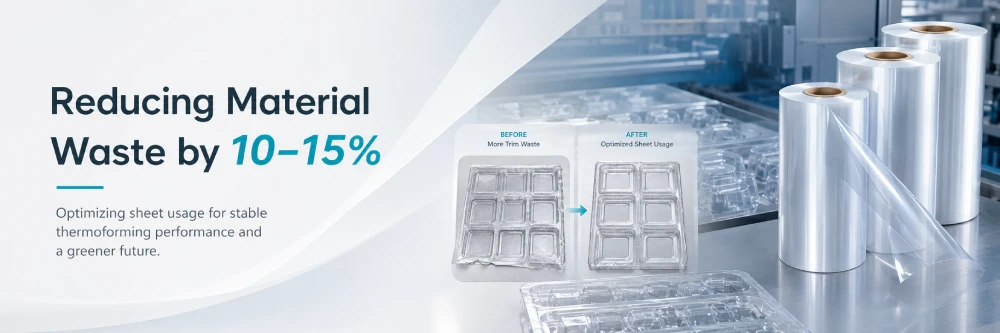
Consistent sheet dimensions and roll feeding help reduce production interruptions and unnecessary material waste.
04 How Fruit Box Design Influences Sheet Selection
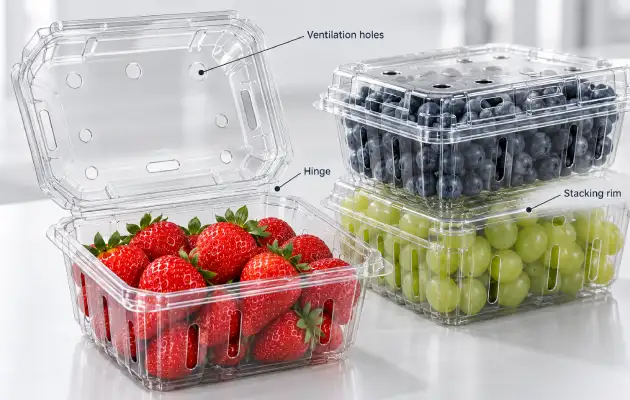
Ventilation openings, reinforced rims, hinges and closure details all affect the requirements placed on the sheet during forming and use.
Although these features belong to the finished packaging design, they should be considered when discussing sheet specifications with the manufacturer.
Ventilation Openings
Many berry and grape boxes include ventilation openings to support airflow and moisture management during cooling and distribution.
The vent pattern depends on the fruit, package dimensions and intended distribution conditions.
From a sheet selection perspective, PET must allow reliable forming and punching without excessive cracking, tearing or deformation around the ventilation openings.
Stacking Strength and Material Distribution
Filled fruit boxes may experience stacking loads during packing, transportation and retail display.
Finished-part stiffness depends on starting sheet thickness, formed-wall distribution, corner geometry and reinforced rim design.
When evaluating thinner sheet, converters should reassess the finished package’s stacking performance instead of relying on flat-sheet thickness alone.
Clamshell Hinges and Closure Features
Hinged fruit clamshells include formed hinges and locking features that require appropriate local material distribution.
Performance depends on the sheet, forming conditions and package geometry. The converter should validate opening and closing behavior using production samples.
For open trays, denesting and reliable handling may be more important than hinge performance.
What About PP or PS/HIPS for Vegetable Trays?
Not all fresh produce packaging requires transparent PET. Some opaque vegetable and mushroom trays may use PP, PS/HIPS or other materials depending on forming requirements, stiffness, cost and packaging design.
Black tray color alone does not identify the polymer. Buyers should confirm the actual material rather than assume that every black produce tray is PP.
For transparent fruit display boxes and clamshells, APET and RPET remain the primary focus of this guide.
05 PET Fruit Packaging Sheet: Purchasing Checklist
A practical RFQ should describe both the required sheet and the intended fruit packaging application.
This helps the supplier recommend a suitable starting specification and reduces unnecessary sampling.
Information to Share with DESU
- طلب: Fruit type, package format and intended pack weight.
- مادة: Virgin APET or RPET, including recycled-content targets.
- Sheet dimensions: Required thickness and width.
- مواصفات الرول: Roll diameter, core size and winding requirements.
- مظهر: Transparency, allowable tint and reference samples.
- المعالجة السطحية: Anti-fog requirements and intended treatment side.
- Processing: Forming depth, equipment and available part drawings.
- Compliance: Intended food-contact market and documentation requirements.
- Purchasing: Estimated order quantity, sampling requirements and delivery destination.
If the fruit box is still under development, existing samples or drawings can help identify the sheet properties requiring evaluation.
Final material approval should follow representative thermoforming trials and finished-package checks.
06 الأسئلة المتداولة
Can RPET sheet be used for food-contact fruit packaging?
Yes, provided the selected recycled material route and sheet construction meet the applicable food-contact requirements. Supporting documentation should be checked for the intended market and application.
Is RPET always less transparent than virgin APET?
No. High-quality RPET can achieve good clarity. Actual appearance depends on recycled feedstock, processing and sheet construction. Buyers should compare approved physical samples.
Can one PET sheet specification be used for different fruit boxes?
Sometimes, but different forming depths, package weights and structural features may require different starting gauges or processing conditions.
Does every clear fruit box require anti-fog sheet?
No. Anti-fog treatment is mainly relevant where condensation reduces product visibility. The need depends on humidity, temperature changes, ventilation and package design.