Hardware Blister Packaging | Sheet Selection
APET Sheet for Hardware Blister Packaging: Grades, Thickness & تشكيل
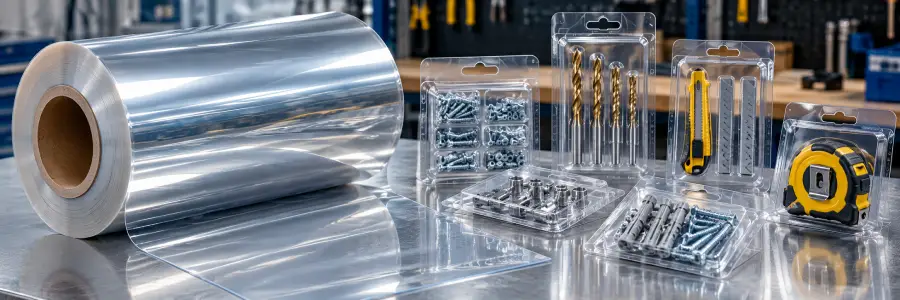
Clear hardware blisters may look similar on a store shelf, but a small screw pack and a deeper tool blister can need different PET sheet specifications. Standard APET works well for many applications. Anti-static PET is another option when static or dust attraction is a concern. For packaging converters, the important decisions are the material grade, starting gauge and roll format.
01 Why APET Works for Hardware Blister Packaging
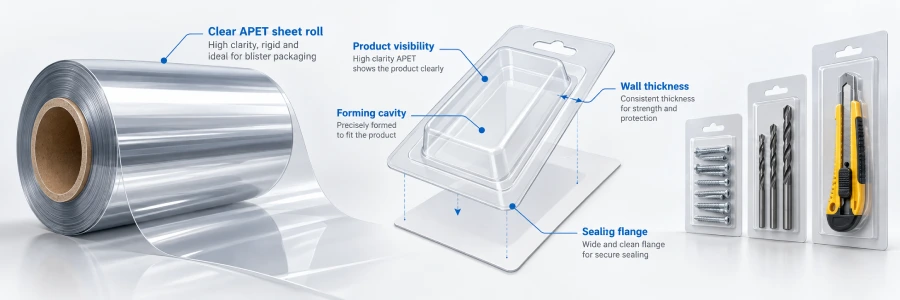
Clear blisters are common in hardware retail packaging for a practical reason: the customer can see the screws, drill bits or other metal components without opening the package.
APET is a good material to start with. It offers transparency, useful rigidity and thermoforming characteristics suited to many blister applications. It can also be supplied as continuous rolls for automatic forming lines.
For the sheet supplier, the main questions are not limited to whether the material is clear. We also need to consider sheet thickness, gauge consistency, surface appearance and the roll dimensions used by the converter.
02 Screws, Drill Bits and Tool Sets: What Changes for the Sheet?
Not all hardware puts the same demands on a formed PET sheet. Product weight, sharp contact points and forming depth can change the starting material requirements, even when all three packages use clear APET.
Often relatively compact packaging. Good clarity, suitable rigidity and a practical starting gauge are the main considerations.
Longer parts and sharp edges can concentrate pressure on the formed sheet. Material toughness and remaining wall thickness deserve attention.
Larger assortments may require deeper cavities or a wider forming web. Starting gauge, forming consistency and roll dimensions become important.
A deeper blister does not always mean using the thickest PET available. The sheet stretches during forming, so starting gauge and wall-thickness distribution need to be considered together. The forming equipment and existing tooling also matter.
If a converter already has a successful hardware blister, its current material specification is a useful reference. For new packaging, samples and forming trials can help establish the right starting gauge.
03 Standard APET, Anti-Static PET or HIPS?
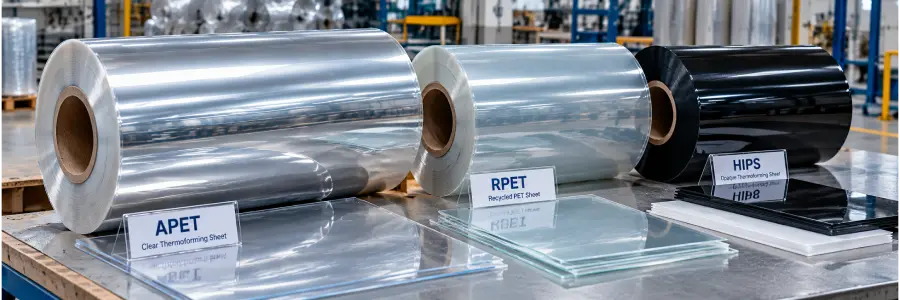
Most ordinary clear hardware blisters can begin with standard APET. Functional PET and HIPS have their places too, but for different reasons.
Material Options for Hardware Packaging
| Sheet Material | Typical Use | Material Priority |
|---|---|---|
| Clear APET | Transparent blisters for fasteners, drill bits, small tools and other retail hardware. | Clarity, rigidity, consistent gauge and thermoforming performance. |
| حيوان أليف مضاد | Clear packaging with specific static-control needs or troublesome dust attraction. | Electrical performance, treatment durability, clarity and forming compatibility. |
| خَواصِر | Black, white or colored hardware inserts, tool trays and opaque packaging components. | Impact properties, stiffness, color and forming behavior. |
HIPS is worth considering for opaque tool inserts or inner trays, but it isn’t a direct substitute for APET when the hardware needs to remain visible.
Which Sheet Would We Quote First?
| Your Situation | Starting Material | ما يجب تأكيده |
|---|---|---|
| General transparent hardware blisters | Clear APET | Gauge, clarity, width and roll size |
| Static buildup or dust attraction is causing problems | حيوان أليف مضاد | Target electrical performance, treatment and service conditions |
| Opaque hardware inserts or tool trays | خَواصِر | Color, stiffness, impact properties and forming needs |
| Existing blister line looking for a new sheet supplier | Match the Approved Grade | Current material, thickness tolerance, width and roll format |
There’s no reason to pay extra for an anti-static grade if ordinary APET is already doing the job. But if static or dust is creating a real problem, it’s worth looking at the treatment options.
Explore DESU materials: رولات صفائح PET و Anti-Static PET Sheet و HIPS Sheet Rolls .
04 How Is PET Sheet Made Anti-Static?
PET is naturally an electrical insulator. Static charge can build up when the sheet is unwound, handled or thermoformed. In some applications, this leads to dust attraction or handling problems.
Two common ways to produce anti-static PET are to incorporate anti-static additives into the material or apply a functional coating to the sheet surface.
Internal Additives vs. Surface Coating
| Comparison | Internal Additives | Surface Coating |
|---|---|---|
| How It Works | A compatible anti-static formulation is incorporated into the PET material. | A functional anti-static layer is applied to the PET sheet surface. |
| Key Consideration | Additive compatibility, optical appearance and electrical performance. | Coating adhesion, surface uniformity and forming compatibility. |
| متانة | Depends on the additive system; some grades are sensitive to humidity or changes over time. | Depends on coating chemistry, handling conditions, adhesion and wear. |
| Buyer Should Confirm | Required electrical performance, test conditions, expected service life and behavior after thermoforming. | |
Is One Method Better?
Not automatically. If the goal is simply to reduce dust attraction on a transparent blister, the requirements may be quite different from those for a controlled ESD application.
We’d first ask whether you have a particular surface-resistance requirement or are mainly trying to solve a static-related problem on the packaging line.
Coated PET is one of the available functional material directions. DESU’s Functional Coating Technology covers anti-static and other surface-property options. The appropriate grade needs to suit the intended forming and electrical requirements.
For important anti-static applications, we’d check the property on the formed material as well as the original sheet. Heating and stretching can affect some treatment systems.
05 PET Sheet Gauge, Forming Depth and Roll Specifications
A customer may ask for “0.4 mm clear PET sheet,” and for a repeat order that can be a useful start. For a new hardware blister, we would also want to know the forming depth and whether the packed hardware is heavy or has sharp contact points.
Some relatively light retail blisters use starting gauges around 0.25–0.60 mm. That’s a reference for selected applications, not a fixed rule. Thicker sheets may be required for deeper or more demanding packaging. DESU’s broader PET range includes options up to 2.0 mm, depending on grade.
How the Application Affects Sheet Gauge
| Application Condition | What We Would Check |
|---|---|
| Small, shallow screw blisters | Standard APET grade, suitable gauge, clarity and roll width |
| Deeper tool or drill-bit blisters | Starting gauge, forming depth and remaining wall thickness |
| Heavier or sharp-edged hardware | Material toughness, potential contact pressure and formed-wall strength |
| High-volume continuous forming | Thickness consistency, web width, winding quality and repeat roll supply |
What Goes into a Roll Specification?
| مواصفة | Information We Need |
|---|---|
| Material Grade | Standard APET, anti-static PET or HIPS for opaque inserts |
| سماكة | Nominal gauge and required tolerance |
| عرض الورقة | Required forming web width |
| Roll Format | Core diameter, roll outer diameter, weight and winding requirements |
| جودة السطح | Clarity, appearance, anti-static performance or other agreed properties |
| كرر العرض | Required batch consistency, order quantity and delivery arrangements |
What If the Blister Needs Card Sealing?
One detail worth mentioning when ordering hardware blister sheet is the sealing method. Some packages use trapped blisters; others are sealed to coated cards.
Standard APET does not necessarily heat-seal to every backing-card coating. If your production requires a specific sealing system, tell us what materials are being used so the suitable sheet or surface requirement can be reviewed.
06 Source PET Sheet Rolls for Hardware Blister Production
If you’re replacing a sheet supplier for an existing blister line, send us the grade and roll details you’re currently using. That’s often the quickest way to start a useful discussion.
For a new project, you don’t need every specification finalized before contacting us. Start with the material, approximate gauge, width and the hardware application.
What to Include in Your Inquiry
- مادة: Clear APET, anti-static PET or HIPS
- Sheet dimensions: Thickness, width and tolerance if known
- Roll format: Core diameter, preferred roll diameter or weight
- طلب: Screws, drill bits, tools or other hardware; approximate forming depth
- Special requirements: Anti-static performance, surface appearance, color or sealing needs
- Purchase information: Estimated quantity, destination and sample requirements
Need a PET Sheet Supplier for Your Blister Line?
DESU supplies clear APET and functional PET sheet rolls for thermoforming converters. Share your current specification or tell us about the material you’re looking for. We can review the available grades, roll sizes and supply options with you.
07 Common Questions from Hardware Blister Converters
Does anti-static PET remain effective after thermoforming?
That depends on the material grade, treatment and forming conditions. If the electrical property is important, check the formed material rather than relying only on the flat-sheet result.
Can anti-static treatment affect PET transparency?
It can, depending on the formulation or coating. If the blister needs good optical clarity, request samples to check both appearance and electrical performance.
Can the same APET grade be used for different hardware blister sizes?
Often, yes, provided the forming and performance requirements are compatible. The same material grade may still need different starting gauges for different cavity depths.
Can DESU match an existing PET sheet roll specification?
Send the current material grade, thickness, width, core size and relevant quality requirements. A physical sheet sample can also help us review the available supply options.